
Reviewed · STOCKHOLM TOURS
Private Half Day Tour: Viking History Trip from Stockholm Including Sigtuna
The most rewarding part of this half-day outing is that it takes you beyond Stockholm’s museums and into the places where Viking-era life actually unfolded. You’ll see grave fields, original runestones, an old assembly site, and Sigtuna, often described as Sweden’s first capital. I like the personal format, and I like the mix of archaeology and living town history. The main drawback is the price: at $532.19 per person, this makes the most sense for a small private group that values a guide and door-to-door transport.
You’ll have time to ask questions and adjust the pace, something that matters when runic inscriptions begin to blur together. The five-hour schedule is efficient, but lunch is brief, traffic can affect the return, and some church interiors may be closed.
Key points to know before booking
- Three original Viking-era sites: Broby Bro, the Jarlabanke Runestones, and Arkils tingstad each show a different side of power, belief, travel, and community life.
- Estrid’s story adds a human face: Broby Bro includes runestones linked to Estrid, one of the best-known Viking women in the area.
- Sigtuna supplies the medieval town setting: Walk its curved old street, see church ruins, and visit Mariakyrkan if it is open.
- A private vehicle saves time: Pickup and return are offered for central Stockholm hotels, ports, and accommodations, subject to the stated distance limits.
- Guides shape the experience: Past guides have included Olof, Jakob, Gustav, Gabriel, Calle, Yonatan, and Charles, with praise focused on clear storytelling and flexibility.
- Plan for a quick meal: Lunch is not included, and the Sigtuna stop allows about 40 minutes for eating before the town walk.
Why this private Stockholm Viking tour works
This is not a tour of grand stone monuments. Much of what you see consists of carved stones, grassy burial grounds, low ruins, and traces of roads and meeting places. That can sound modest compared with Rome or Athens, but the appeal is different. You are looking at the actual countryside of Viking-age Sweden, not a modern reconstruction built only for display.
A good guide is essential here. Without one, a runestone can look like a weathered slab with mysterious scratches. With context, its inscriptions can reveal family ties, travel, faith, land ownership, and political reach. The guide also explains a useful point that is easy to miss: Viking was a verb describing an activity, not simply the name of a people.
The private setup is the tour’s strongest practical feature. Your group travels in its own vehicle, with a maximum size of 16 people, and the guide can respond to your interests. If you want more explanation at a runestone, you can ask. If your group is especially interested in folklore, laws, trade, or religious change, the day can lean in that direction.
The experience starts at 9:30 a.m. and lasts about five hours. That timing lets you visit several sites before returning to Stockholm in the early afternoon. You will spend part of the day driving through the Swedish countryside, so this is best viewed as a compact regional excursion rather than five hours of continuous walking.
More Historical Tours in Stockholm
- Stockholm: Ghost Walk and Historical Tour
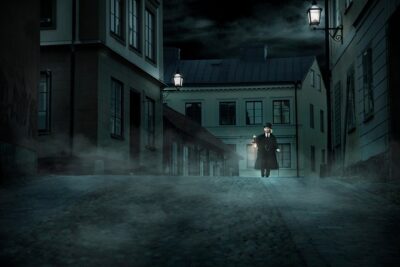
★ 4.7 · 2,206 reviews - The Original Stockholm Ghost Walk and Historical Tour – Gamla Stan
★ 4.5 · 1,165 reviews - Stockholm: Old Town Historical Walking Tour
★ 4.9 · 344 reviews
Broby Bro and Estrid’s grave field
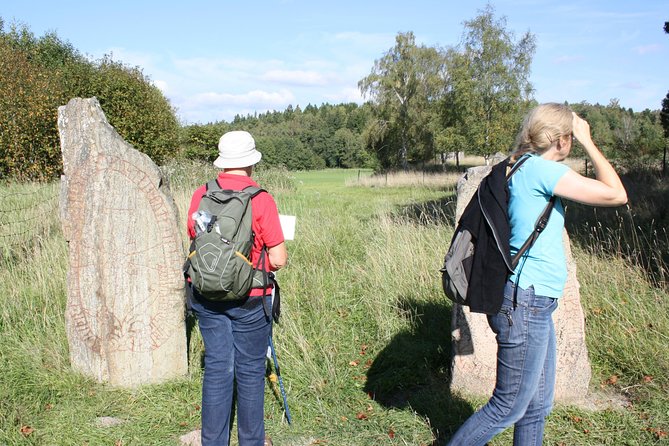
Broby Bro is the strongest opening because it gives you several pieces of the Viking story in one place. You visit a Viking grave field and three imposing runestones, including one that mentions Jerusalem. The stones were raised by women connected with Estrid, whose life offers a rare way to discuss the role of women in Viking-age families and property networks.
The site also introduces daily life in Scandinavia during the 8th to 11th centuries. Your guide explains why Viking raids became such a powerful part of the modern image, while placing that activity beside farming, family life, travel, law, and trade. That broader view is valuable. You are less likely to leave with the cartoon version of Vikings as nothing but raiders in horned helmets.
You have about 55 minutes here. That is enough time to walk among the stones and grave field while listening to the story, though anyone who wants to study every inscription closely may wish for more. Admission is included, and there is no separate ticket to buy.
Estrid is an especially good subject for this stop. Runestones often preserve the names of men, but her connection to the stones helps show that women could commission monuments and shape how a family was remembered. Ask your guide to point out how the inscriptions connect people and places. The reference to Jerusalem also hints at a world that reached far beyond this corner of Sweden.
Jarlabanke’s causeway and the meaning of power
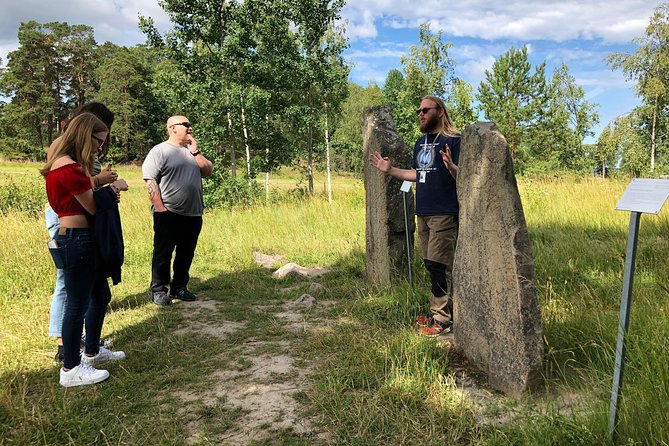
The next stop is the Jarlabanke Runestones in Täby, reached by a short walk from the vehicle. The stones sit beside a reconstructed Viking causeway, giving you a physical sense of how roads and crossings formed part of local power.
Jarlabanke was a Viking lord, and the guide uses his memorials to explain how such figures ruled, displayed status, and influenced the people around them. The subject is not just one ambitious man. It is also about who controlled roads, land, movement, and trade.
This stop lasts about 20 minutes, so it is more of a focused explanation than a long exploration. That short visit helps the schedule, but it also means you should listen closely. The causeway and runestones are most interesting when you connect them to the larger network of routes that carried goods, people, and ideas across Scandinavia.
The site gives the tour a useful change of scale. Broby Bro feels personal, centered on graves and family memory. Täby shifts toward leadership and public display. Together, the stops show how Viking society worked at both household and regional levels.
Arkils tingstad, where law met authority
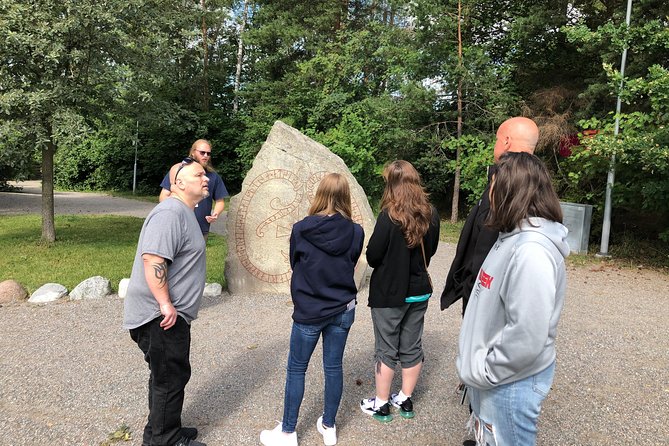
Arkils tingstad is one of the more unusual stops. This is a well-preserved assembly place, or thing site, with runestones linked to the Skålhamra family. In Viking-age Scandinavia, a thing was a meeting where people gathered to settle disputes, make decisions, hear laws, and reinforce authority.
You have about 55 minutes here, which gives the guide room to explain the setting rather than simply point at stones. This is where the tour moves from objects to institutions. The site helps you picture a society in which law and politics were handled in public gatherings, with powerful families gaining influence by organizing and controlling those spaces.
The discussion can include Viking-age customs, laws, and the relationship between kings, local lords, and ordinary people. That is one of the tour’s best features for anyone who wants more than a collection of sightseeing stops. You are not only seeing what survived. You are learning how a community may have functioned.
Again, expectations matter. The assembly site is not a complete building with intact walls. Its value lies in the setting, the runestones, and the story your guide builds around them. If you prefer museums with many displayed objects, you may find the physical remains sparse. If you enjoy connecting small clues to a larger story, this can be one of the most rewarding stops.
More viking history days
- Stockholm: The Viking Museum Exhibition and Viking Ride
★ 4.5 · 667 reviews - Entrance ticket to The Viking Museum
★ 4.0 · 301 reviews - Viking History, Runes & Countryside 9h Tour to Sigtuna & Uppsala
★ 4.5 · 283 reviews - Viking History and Swedish Countryside Tour to Sigtuna & Uppsala
★ 4.5 · 162 reviews
Sigtuna, Sweden’s early capital by the lake
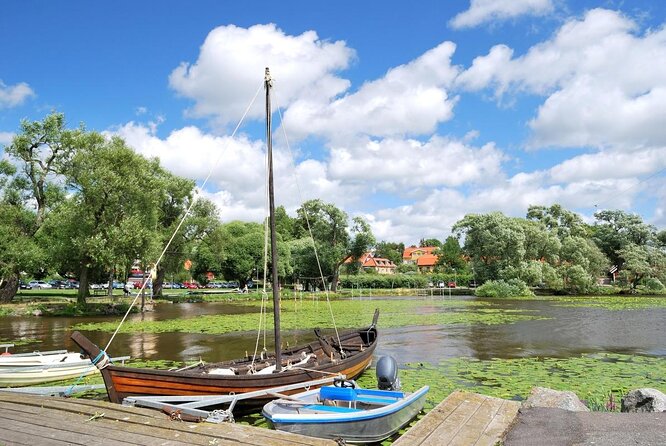
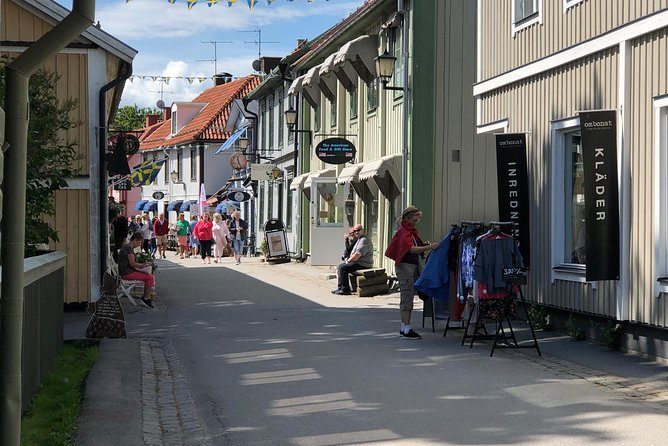
Sigtuna changes the mood completely. After the rural archaeological sites, you arrive in a small wooden town with a curved main street that preserves the shape of its Viking and medieval past. It is often presented as Sweden’s first capital, and the town’s old layout makes that early importance easier to imagine.
The schedule gives you about 40 minutes for lunch, followed by another 40 minutes for walking and historic sights. Lunch is at your own expense, so plan to choose something quickly rather than expecting a long restaurant break. Past visitors have particularly enjoyed Swedish meatballs here, and the old-fashioned setting adds to the sense of place, but the tour does not specify a fixed restaurant.
The main street is a pleasant contrast to the open fields around the runestones. You can walk past wooden buildings, follow the old curve of the road, and get a feel for Sigtuna as a lived-in town rather than an isolated archaeological park. A candy and chocolate shop has also been a useful stop for inexpensive gifts, though purchases are optional and not part of the tour.
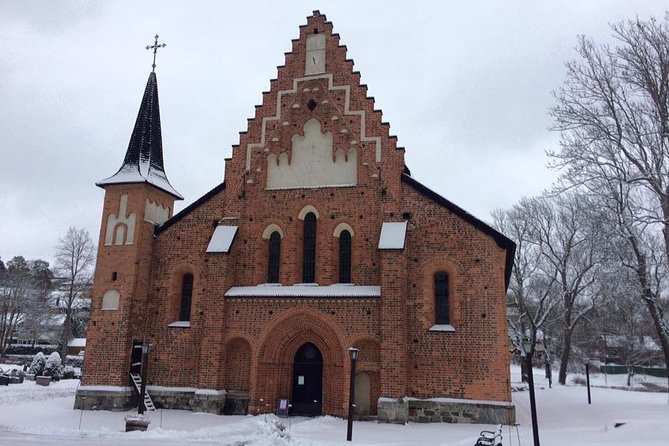
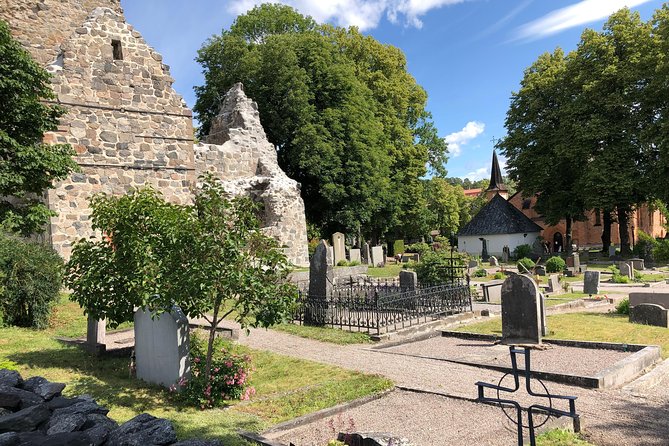
The town walk includes church ruins and Mariakyrkan, the surviving church associated with a once-powerful monastery just outside the city. Mariakyrkan is visited if open, so do not count on entering. The religious sites help explain the shift from pre-Christian customs to medieval Christianity, a major change in Swedish history.
S:t Olofs Church Ruins and the move to Christianity
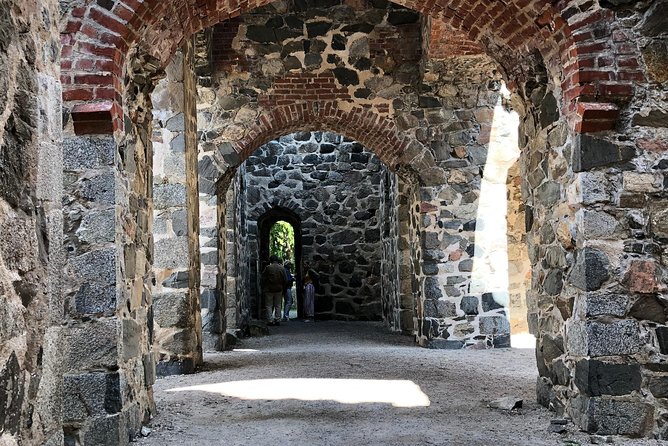
S:t Olofs Church Ruins are the final specific stop. The visit lasts about 10 minutes, making it a quick look rather than a long guided walk. Still, the ruin is important: it is the largest and best-preserved of the three church ruins around Sigtuna and is also described as the oldest, built around a holy well between about 1080 and 1120.
That date places the church at a useful turning point. The tour begins with burial grounds, runic memorials, and Viking assemblies, then ends with a Christian church built at a sacred location. The sequence gives you a clear sense of how beliefs and public life changed over time.
The ruin is not a complete church interior, so keep your expectations realistic. Its appeal comes from the remaining structure, the holy-well setting, and its place in Sigtuna’s religious past. Some visitors have been lucky enough to enter a church that had recently reopened after years of renovation, but access depends on opening conditions.
Guides, storytelling, and the private format
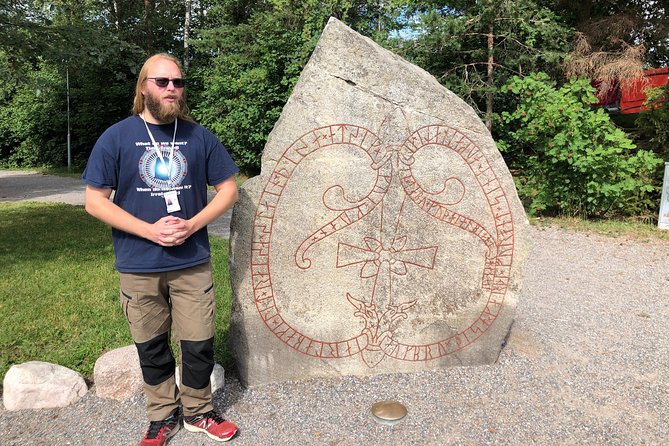
The guide can make or break a tour built around stones and ruins. Guides named Olof, Jakob, Gustav, Gabriel, Calle, Yonatan, and Charles have been praised for clear explanations, entertaining folklore, and willingness to answer questions. One guide was especially adaptable to a group’s interests, which is exactly where a private tour earns its keep.
Some guides also share Swedish and Scandinavian folklore during the drives. That helps fill the time between stops and keeps the history from feeling like a string of disconnected dates. The best approach is to ask questions early. Tell the guide if you care most about women in Viking society, trade routes, religion, warfare, or the meaning of runes.
There is one communication issue to consider. A guest with hearing difficulties found that a strong accent made it hard to catch every detail. If that may affect you, contact the operator before the tour and explain your needs. The company has indicated that a guide who lived in the United States may be available, but you should treat that as a request rather than a guarantee.
The private vehicle is also useful for cruise passengers and anyone with limited time in Stockholm. The guide handles the driving, and you can focus on the countryside and the conversation. Transfer times vary with traffic, so the five-hour estimate should not be treated as a precise timetable.
Pickup details, group size, and the real cost
Pickup is offered from central Stockholm hotels, ports, and other accommodations. The information gives two distance limits, within 5 kilometers and within 3 kilometers of Stockholm Central Station, so confirm your exact address when booking. Pickup is not included from Nynäshamn Harbour. From there, you need to reach central Stockholm by train or cruise bus and meet the tour there.
Cruise pickup instructions vary by pier. At Stadsgården, Frihamnen, and Värtahamnen, the guide waits outside the relevant terminal or near the tourist buses with an A4 sign marked Viking Tours. Check your ship’s pier number carefully, since the instructions differ for S165 and S167, F638, and V523.
The minimum booking is two people, and children must be accompanied by an adult. The private group can reach 16 people, so private does not always mean just two or four. Ask about the expected group size if that matters to you.
At $532.19 per person, the tour is expensive for five hours. The cost includes the vehicle, driver, guide service, taxes, and eligible hotel or port pickup and return. It does not include lunch or personal purchases in Sigtuna.
The value improves when several people share the private experience and when you would otherwise need to arrange multiple regional transport connections. It also suits cruise passengers who cannot spare a full day. If you only want to see a few runestones and do not care about the explanations, the price may feel hard to justify. If you want the sites connected by a clear story, the private attention and transport do more of the work.
Who should book this half-day outing?
I would choose this for a history-minded couple, family, or small group that has already seen central Stockholm and wants a countryside day without renting a car. It is also a strong fit for cruise passengers with a morning available, provided your ship arrives at one of the supported Stockholm ports.
You should enjoy walking outdoors for short periods and be comfortable with ruins that require imagination. The tour is not centered on reconstructed Viking buildings, costumes, or a large museum collection. It is about original places and the stories attached to them.
It may not suit someone seeking a relaxed lunch, long time in Sigtuna, or dramatic monuments. The schedule moves quickly, and the drive between sites is part of the day. A nine-hour version may be a better choice if you want more time for the subject, since the shorter tour can only sketch a broad story.
Free cancellation is available up to 24 hours before the start time. Bookings require at least two people, and if the minimum is not met, the operator offers another date or experience, or a full refund.
Should you book it?
Book this tour if you want to understand Viking Sweden through original runestones, burial grounds, roads, assembly places, and early churches. The strongest moments come when a guide such as Olof, Gustav, Gabriel, or one of the other named guides turns a quiet field into a story about family, law, power, trade, and belief.
Skip it if your budget is tight or if you expect large ruins and a long, leisurely meal. At 4.8 out of 5 with 92 percent recommending it, the experience has a strong record, but the price and outdoor archaeology format are real considerations. For the right small group, the private transport and flexible storytelling make this one of the more efficient ways to get beyond Stockholm and into Sweden’s Viking past.
FAQ
How long is the Viking history tour from Stockholm?
The tour lasts approximately five hours and begins at 9:30 a.m., with an expected return to your Stockholm hotel in the early afternoon.
What sites are included?
The tour visits Broby Bro, the Jarlabanke Runestones in Täby, Arkils tingstad, Sigtuna, and S:t Olofs Church Ruins.
Is hotel pickup included?
Pickup and drop-off are included for central Stockholm hotels, ports, and accommodations within the stated distance limits of Stockholm Central Station. Confirm your exact location because the details list both 3-kilometer and 5-kilometer limits.
Can I be picked up at Nynäshamn Harbour?
No. Pickup is not included at Nynäshamn Harbour. You must travel to a meeting point in central Stockholm by train or cruise bus.
Is lunch included?
No. Lunch in Sigtuna is at your own expense.
Is the tour private?
Yes. Only your group participates, with a maximum private group size of 16 people. A minimum of two people is required per booking.
What language is the tour offered in?
The tour is offered in English.
Can children join the tour?
Yes. Children must be accompanied by an adult.
What is the cancellation policy?
You can cancel at least 24 hours before the start time for a full refund. Cancellations or changes made less than 24 hours before the experience are not accepted for a refund.
More Sigtuna Day Trips
- From Stockholm: Uppsala and Sigtuna Viking Sites Tour
★ 4.7 · 157 reviews - Viking History Small Group Tour from Stockholm: Half Day Including Sigtuna
★ 4.5 · 111 reviews - Private Full Day Viking History Tour from Stockholm Including Sigtuna and Uppsala
★ 5.0 · 51 reviews - Stockholm: Sigtuna and Uppsala Viking History Day Tour
★ 4.7 · 41 reviews
Just added around Stockholm
- Beautiful Stockholm Small Group Walking Tour★ 5.0 · 3 reviews
- Private Golden Hour Photo Walk in Stockholm★ 5.0 · 3 reviews
- ROYAL Castle Skokloster and Viking Sigtuna (private tour)★ 4.5 · 3 reviews
- Stockholm Port to Stockholm Arlanda Airport (ARN) – Departure Private Transfer★ 3.5 · 3 reviews
- Stockholm Ghost Hunt: Self-Guided Tour and Puzzle Adventure★ 4.5 · 3 reviews
- Swedish Beer Tasting Tour in Stockholm Old Town Pubs★ 5.0 · 3 reviews
- Private Photography workshop in Stockholm★ 5.0 · 3 reviews
- Private blood, ghosts and folklore Old Town 2h Stockholm tour★ 4.0 · 3 reviews
Stockholm Tours, compared.

Stockholm: City Archipelago Sightseeing Cruise with Guide
Read our review →
Stockholm: Skansen Open-Air Museum Admission Ticket
Read our review →
The Original Stockholm Ghost Walk and Historical Tour – Gamla Stan
Read our review →
Browse the lists this tour appears in