
Reviewed · STOCKHOLM TOURS
Viking History and Swedish Countryside Tour to Sigtuna & Uppsala
A thousand-year-old bridge, a giant stone covered in runes, royal burial mounds, and Sweden’s oldest town make this Viking history tour far more substantial than a quick museum visit. You spend the day outside Stockholm, moving through the countryside and linking scattered sites that are difficult to reach by public transport.
I like the mix of outdoor ruins and living towns, especially Sigtuna and Old Uppsala. I also like the small-group minibus, hotel pickup, and guides such as Urban, Angus, Carl, and Olof, who are often praised for strong storytelling and humor. The trade-off is clear: nine hours is a long day, and the tour may feel too detailed if runestones and church ruins are not your main interest.
Key points to know before booking
- Jarlabanke’s Bridge and Arkils Assembly Site: See the remains of a Viking causeway and an old meeting place linked to law, politics, and local power.
- Granby’s enormous runestone: Study one of Sweden’s longest Viking Age inscriptions and the nearby foundations of Viking houses.
- Sigtuna’s wooden streets: Walk through Sweden’s oldest town, with time for shops, old buildings, and a lakeside setting.
- Old Uppsala’s Royal Mounds: Stand beside three large burial mounds tied to early Swedish kings and royal tradition.
- A guide-led history day: The quality of the experience depends heavily on your guide’s pacing, clarity, and ability to make long explanations engaging.
- Bring practical gear: Wear comfortable shoes, carry water, and pack rain protection. Much of the day takes place outdoors.
A full day tracing Sweden before Stockholm
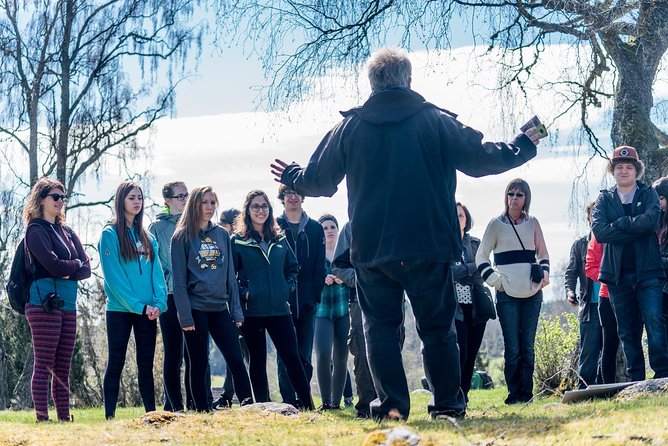
This is not a tour built around one grand attraction. It is a chain of smaller places that together show how Sweden developed from Viking settlements and regional assemblies into a Christian medieval kingdom.
You leave central Stockholm in an air-conditioned minibus and head north through the countryside. Hotel pickup is included within the general central Stockholm pickup zone, though the exact time and location are confirmed one or two days before departure. During the busiest periods, you may be asked to meet at another central location to reduce the time spent collecting passengers.
The advertised maximum is 17 people. That is still much more personal than a large coach, but the minibus can feel tight when full, particularly in the back row. One useful point from the feedback is that seating comfort may depend on when you are picked up, since later pickups leave fewer seat choices.
The tour is strongest for people who want context. Your guide does not simply point at a stone and move on. The sites are used to explain inheritance, power, law, religion, family ties, burial customs, and the practical lives of people who lived here a thousand years ago.
That depth can be a pleasure or a burden. Guides including Urban and Angus have been praised for clear explanations, wit, and care for the group. At the same time, some departures have felt too talk-heavy, with visitors finding it hard to follow long explanations or becoming tired after several similar stones and ruins.
More Historical Tours in Stockholm
- Stockholm: Ghost Walk and Historical Tour
★ 4.7 · 2,206 reviews - The Original Stockholm Ghost Walk and Historical Tour – Gamla Stan
★ 4.5 · 1,165 reviews - Stockholm: Old Town Historical Walking Tour
★ 4.9 · 344 reviews
Täby and Jarlabanke’s Bridge: power written in stone
The first part of the route brings you to the Täby area. Täby Church is seen as a drive-by stop, so do not expect a full church visit here. The medieval building dates from the 13th century and reflects both Romanesque and Gothic styles.
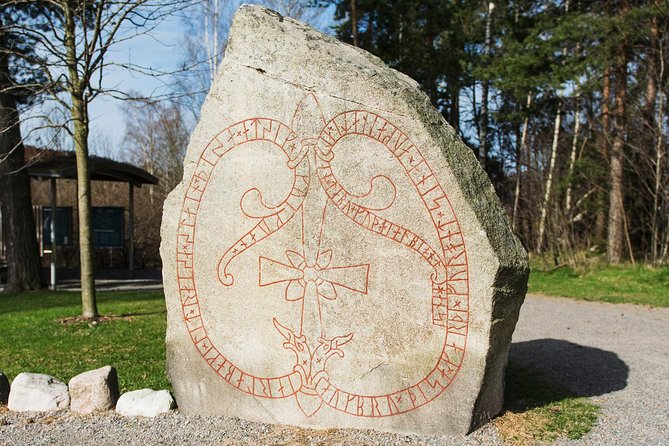
The more important stop is Jarlabanke’s Bridge, an 11th-century Viking causeway bridge. The bridge is associated with Jarlabanke, a powerful local chieftain who marked the site with runestones naming himself and members of his family.
This is one of the tour’s most useful early lessons. Runestones were not only memorials for the dead. They could announce property, family connections, religious beliefs, and political strength. Jarlabanke’s inscriptions present him as a man with the authority and wealth to build a bridge, while also ensuring that his name remained visible.
The bridge itself is not a complete working structure in the modern sense, so adjust your expectations. You are looking at an archaeological remnant rather than walking across a grand Viking crossing. Its value comes from the inscriptions and the guide’s explanation of what the site says about status and control.
Arkils Tingstad beside Lake Vallentuna
At Arkils Tingstad in Vallentuna, the subject shifts from individual power to community decision-making. This ancient assembly site is made up of stones arranged in a square. It is thought to have served as a meeting place where local people gathered to settle disputes, agree on rules, and make decisions.
The word þing, or ting, refers to this type of public assembly. It is a useful reminder that Viking society was not simply a world of raiders and kings. Law and negotiation mattered. Local communities needed places where disputes could be heard and agreements made.
You spend about 30 minutes here, with another short period at nearby Lake Vallentuna. The lake covers roughly six square kilometers and is surrounded by woods and open views. The stop gives you a break from built-up Stockholm and adds a natural setting to the historical material.
This is also an outdoor stop, with uneven ground and no shelter guaranteed. In warm weather, it should be pleasant. On a cold, wet day, the same pause can feel exposed, so bring a waterproof jacket and wear shoes that can handle grass and rough paths.
Granbyhällen and the remains of a Viking farm
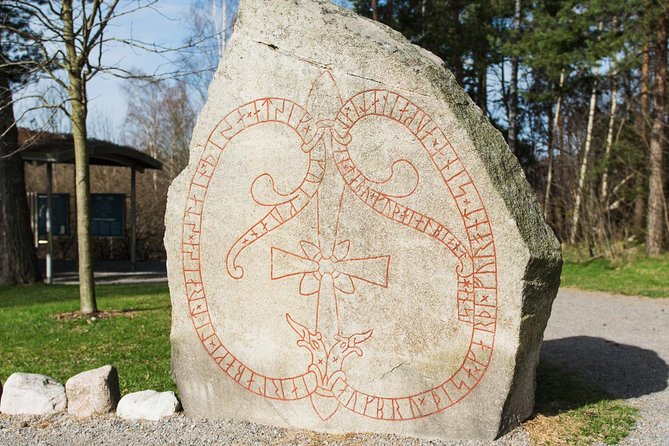
Granby may be the most important stop for understanding ordinary Viking life. The Granbyhällen is a huge exposed rock covered with runes. Its inscription is among the longest and most informative Viking Age texts in Sweden, and it may have functioned partly as an inheritance record for a local family.
That detail makes the stone more personal than a simple memorial. It points toward land, relatives, property, and the question of who had rights to what. Your guide will help translate the markings and place the family story within the wider society of the period.
Nearby are well-preserved foundations of Viking houses. You can step inside the outline of a longhouse and picture the basic shape of the home where the family lived. The foundations do not recreate the building, furniture, or daily routines for you, so much of the experience depends on the explanation.
You have about 25 minutes at the runestone and house foundations. That is enough for a focused visit, but not enough for a leisurely archaeological study. If you enjoy runes, this is a highlight. If you prefer reconstructed villages or hands-on displays, it may feel spare.
More viking history days
- Stockholm: The Viking Museum Exhibition and Viking Ride
★ 4.5 · 667 reviews - Entrance ticket to The Viking Museum
★ 4.0 · 301 reviews - Viking History, Runes & Countryside 9h Tour to Sigtuna & Uppsala
★ 4.5 · 283 reviews - From Stockholm: Uppsala and Sigtuna Viking Sites Tour
★ 4.7 · 157 reviews
Hökeriet, fika, and a pause at the farm
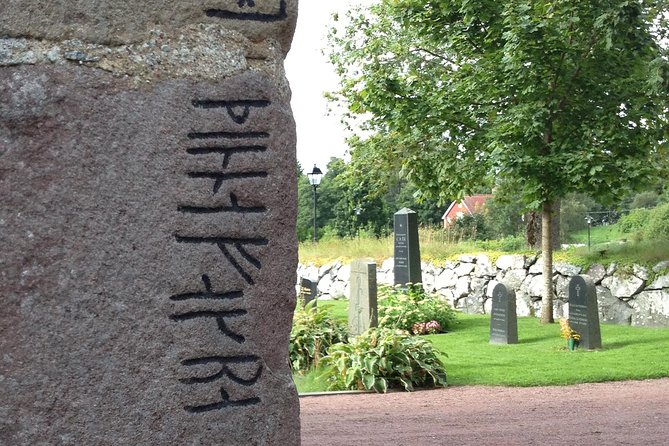
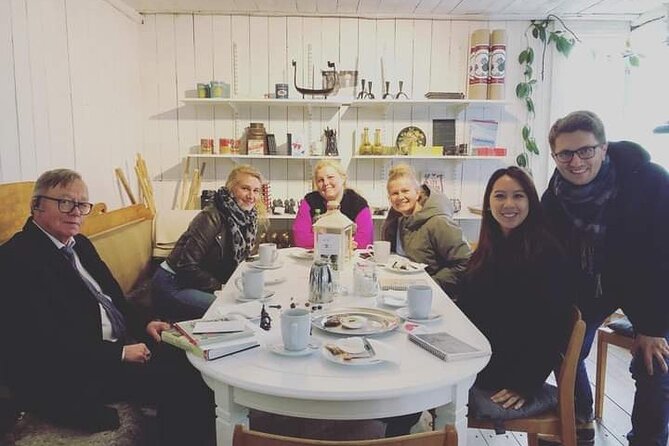
The small shop known as Hökeriet is located near the Granby farm. On most tours, you can stop for Swedish fika in a cozy farmhouse, served by a farm co-owner or someone connected with the family. Fika is more than a coffee break. It is a useful pause in a day that includes a lot of standing and listening.
The stop lasts about 20 minutes. A regional pastry such as rhubarb tart has been served on some departures, though the exact offering can vary. You can also browse local handicrafts and Viking-themed souvenirs.
Food and drinks are not included in the tour price, so carry some Swedish kronor or a payment card for lunch and refreshments. The farm break is a pleasant extra, but do not treat it as guaranteed in exactly the same form on every departure.
Sigtuna, Sweden’s oldest town
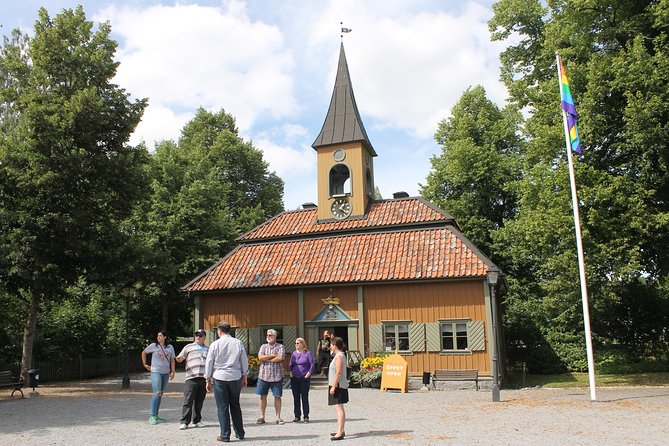
Sigtuna changes the pace. Founded around AD 980, it is one of the oldest towns in Sweden and has a compact historic center of cobbled streets, old wooden buildings, small shops, and church remains.
You get about an hour here, which is enough to walk around and absorb the town’s character. Sigtuna is a place to wander rather than rush from one sight to another. Look for the contrast between the quiet streets and the town’s importance as an early political and trading center.
St. Mary’s Church and other old religious remains help show how Christianity became part of Swedish public life. The Sigtuna Museum offers more context, though the tour does not promise a museum visit. You have independent time, so use it for a short walk, a look at the shops, or a quiet view toward Lake Mälaren.
Lunch is taken during the day at your own expense, and Sigtuna is the natural point for it. The hour can feel short if you want a full meal, shopping time, and extensive sightseeing. One practical choice is to keep lunch simple so you have time to explore.
Sigtuna is also the stop most likely to leave you wishing for longer. The town has enough charm for a separate half-day visit, but extending this stop would mean cutting another historical site or making an already long tour even longer.
Uppsala Cathedral and the shift to Christian Sweden
The route continues to Uppsala, one of Sweden’s major historic cities. You visit Uppsala Cathedral for roughly 20 minutes. Its Gothic interior, tall vaults, stained glass, and pointed towers offer a striking contrast to the open fields, burial mounds, and rough runestones seen earlier.
The cathedral is tied to Sweden’s Lutheran tradition and contains the tomb of Gustav Vasa, the king associated with the Swedish Reformation. The Cathedral Museum and Treasury are nearby, but the schedule does not allow much time for a full museum visit.
Twenty minutes is enough to step inside, look up at the architecture, and hear the main historical points. It is not enough for a slow examination of every chapel, tomb, or display. If religious art and medieval architecture are central interests for you, plan a separate return visit to Uppsala.
You also get some independent time in modern Uppsala. This is an important balance in the schedule because the tour is not only about prehistoric and Viking sites. You can see how the old cathedral and university city fit into present-day Sweden, even though the time remains limited.
Old Uppsala and the Royal Mounds
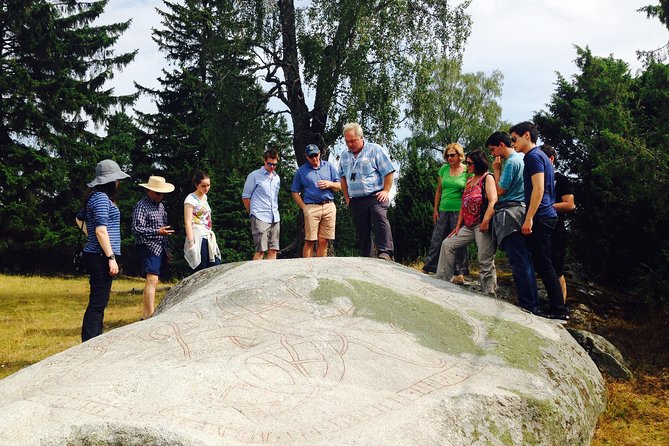
Gamla Uppsala, or Old Uppsala, is the final major historical stop. Three large burial mounds dominate the site. They date from the 6th and 7th centuries and are traditionally linked with early Swedish kings known as Aun, Egil, and Adils.
Archaeological work has found grave goods such as weapons and jewelry, offering clues about rank, trade, craft, and ceremony. The mounds are often connected with Swedish kingship, though the traditional names and legends should not be treated as simple proven biographies.
The setting is powerful because it is open and physical. You are not looking at a small object behind glass. You can see the scale of the mounds and the space around them, which helps explain why this was an important religious and political center.
The visit lasts about 30 minutes. As with Granby, the site rewards an interest in interpretation. Without a guide, you see three impressive hills. With a good explanation, you begin to understand their place in Sweden’s early history and the transition from older beliefs to Christianity.
How much history is too much?
This tour offers a lot of information. That is its central strength, but also its main weakness.
The best guides make the material lively with family stories, political rivalries, explanations of runic writing, and links between Viking customs and later Swedish institutions. Urban has been singled out for his energy, humor, and broad command of Swedish and world history. Olof has been praised for warmth and wit, while Carl is known for informative commentary and dad jokes. Angus is also associated with strong organization and attention to practical needs.
Still, guide style can vary. Some people want every inscription explained. Others would rather hear a short overview, take photographs, and move on. At certain stops, you may hear more detail than you can comfortably absorb, especially after several runestones and church sites.
Some tours use in-ear audio devices, which can make it easier to hear commentary while standing outside. This is helpful when the guide is speaking near traffic or when the group spreads out, but clear pacing still matters. If you have trouble hearing or following the explanation, ask politely for shorter sections or a repeat.
Comfort, weather, and what to pack
Nine hours in a minibus and at outdoor sites requires sensible preparation. You will stand on grass, near stones, around ruins, and beside open historical sites. Comfortable walking shoes are more important than stylish footwear.
Bring:
- Water, especially on warm days
- Rain gear and an extra layer
- A charged phone for photographs
- Money for lunch and drinks
- Sun protection in bright weather
- Patience for a long day with several stops
The minibus is air-conditioned, but one person found the vehicle cold on a cloudy, windy day. Vehicle temperature can be hard to please in a mixed group, so dress in layers rather than relying on the heater or air-conditioning.
There are restroom and food breaks during the day, and guides have adjusted pauses for dietary needs. The tour is not recommended for children under eight. Most adults can take part, but the amount of standing, outdoor walking, and historical explanation may be tiring for younger children.
Is $274.19 a fair price?
At $274.19 per person, this is not a cheap sightseeing outing. The price includes central Stockholm pickup and drop-off, transport in an air-conditioned minibus, and a professional guide for about nine hours. It does not include food or drinks.
The value depends on how you would otherwise reach these sites. Sigtuna, Granby, Arkils Tingstad, Jarlabanke’s Bridge, Uppsala Cathedral, and Old Uppsala are spread across the region. Visiting them independently would require planning several transport connections, researching the sites, and arranging your own historical context.
You are paying mainly for access and interpretation, not for expensive entry tickets. Most stops are viewed without an admission charge. If you enjoy self-guided travel and have plenty of time, the price may feel high. If you have only a few days in Stockholm and want one organized day outside the city, the cost is easier to justify.
The group discount may improve the value for larger parties. Since the tour is often booked well in advance, reserve early if your Stockholm dates are fixed. Free cancellation is available up to 24 hours before the start time, subject to the stated minimum-group condition.
Who should book this day trip?
I would choose this tour if you are genuinely interested in Viking society, runestones, early Swedish politics, medieval churches, and the way old sites connect with modern towns.
It suits you especially well if:
- You want to get beyond central Stockholm
- You prefer a guide-led day to independent transport planning
- You enjoy stories about law, family, religion, and kingship
- You like combining rural sites with Sigtuna and Uppsala
- You can handle a long day with frequent outdoor stops
I would hesitate if your main goal is relaxed sightseeing. Sigtuna receives only about an hour, Uppsala Cathedral about 20 minutes, and the schedule includes several sites that look similar unless you are eager to hear the historical distinctions.
Should you book the Viking History and Swedish Countryside Tour?
Book it if runestones and early Swedish history are high on your list. The tour gives you a broad regional view that would be hard to assemble in one day on your own, and the best guides turn isolated stones and grassy mounds into human stories.
Skip it if you want a slow day in Sigtuna or Uppsala, or if long explanations wear you down. For the right person, this is a serious, rewarding history day. For everyone else, it can become nine hours of stones, churches, and information. Bring water, wear good shoes, and go in ready to listen.
FAQ
How long is the Viking History and Swedish Countryside Tour?
The tour lasts approximately nine hours, including transport from Stockholm and the return journey.
Where does the tour start?
Pickup is offered from hotels or preferred locations within the general central Stockholm pickup area. The final pickup time and place are confirmed one or two days before departure.
Is hotel pickup guaranteed?
No. Pickup at your chosen hotel is not guaranteed if it falls outside the specified area. In high season, you may also be directed to another central meeting point even if your hotel is inside the pickup zone.
What language is the tour offered in?
The tour is offered in English.
What is included in the price?
The price includes hotel pickup and drop-off within the stated central Stockholm area, transport by air-conditioned minibus, and a professional guide.
Are lunch and drinks included?
No. Food and drinks are not included. You should budget separately for lunch and refreshments during the day.
How many people can join the tour?
The advertised maximum is 17 participants. The minibus may feel cramped when it is full, particularly in the rear seats.
Is the tour suitable for children?
The experience is not recommended for children under eight years old. Most other visitors can participate, but the day includes outdoor stops, standing, and extended historical commentary.
What should I bring?
Bring comfortable shoes, water, rain protection, suitable layers, and a charged phone. Much of the tour takes place outside, and the weather can change.
Can I cancel for a refund?
You can cancel up to 24 hours before the experience start time for a full refund. Cancellations or changes made less than 24 hours in advance are not accepted for a refund. If the minimum number of participants is not met and the tour is canceled, you will be offered another date or experience, or a full refund.
More Sigtuna Day Trips
- Viking History Small Group Tour from Stockholm: Half Day Including Sigtuna
★ 4.5 · 111 reviews - Private Full Day Viking History Tour from Stockholm Including Sigtuna and Uppsala
★ 5.0 · 51 reviews - Stockholm: Sigtuna and Uppsala Viking History Day Tour
★ 4.7 · 41 reviews - Private Half Day Tour: Viking History Trip from Stockholm Including Sigtuna
★ 5.0 · 26 reviews
Just added around Stockholm
- Beautiful Stockholm Small Group Walking Tour★ 5.0 · 3 reviews
- Private Golden Hour Photo Walk in Stockholm★ 5.0 · 3 reviews
- ROYAL Castle Skokloster and Viking Sigtuna (private tour)★ 4.5 · 3 reviews
- Stockholm Port to Stockholm Arlanda Airport (ARN) – Departure Private Transfer★ 3.5 · 3 reviews
- Swedish Beer Tasting Tour in Stockholm Old Town Pubs★ 5.0 · 3 reviews
- Stockholm Ghost Hunt: Self-Guided Tour and Puzzle Adventure★ 4.5 · 3 reviews
- Private Photography workshop in Stockholm★ 5.0 · 3 reviews
- Private blood, ghosts and folklore Old Town 2h Stockholm tour★ 4.0 · 3 reviews
Stockholm Tours, compared.

Stockholm: City Archipelago Sightseeing Cruise with Guide
Read our review →
Stockholm: Skansen Open-Air Museum Admission Ticket
Read our review →
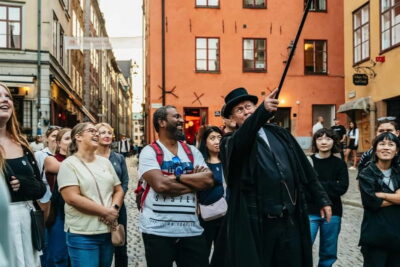
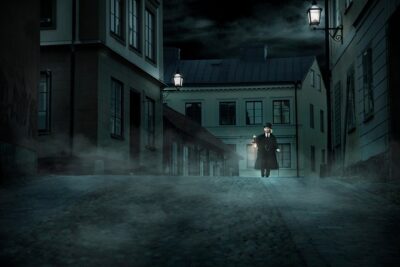
The Original Stockholm Ghost Walk and Historical Tour – Gamla Stan
Read our review →
Browse the lists this tour appears in