
Reviewed · STOCKHOLM TOURS
Private Tour: 3h Viking History from Stockholm to Runic Kingdom
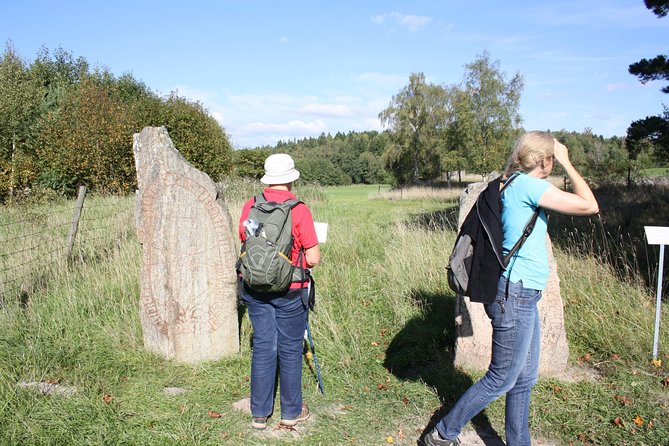
The most rewarding part of this three-hour trip is getting beyond Stockholm to see Viking monuments in their original settings. You walk among grave fields, read stones raised more than 1,000 years ago, cross part of Jarlabanke’s old causeway, and visit the place where Viking leaders met to settle disputes.
I like the private transport, which makes four far-flung stops practical in a short morning. I also like the personal guide service. Guides including Olof, Charlotte, Karl, Angus, Erik, and Quentin have been praised for bringing the people behind the stones to life and answering questions without rushing you.
The main caution is simple: this is an outdoor archaeology tour, not a reconstructed Viking village or a museum visit. Some sites are modest, and about an hour of the three-hour schedule goes to driving. If you want battle reenactments, ships, or rows of reconstructed houses, this may feel quiet.
Key points to know before booking
- Meet Estrid at Broby grave field: See an early Christian Viking burial site and rune stones raised in memory of her family.
- Walk Jarlabanke’s 150-meter causeway: Learn how a self-confident Viking lord used stones and monuments to announce his power.
- Visit Arkils tingstad: Stand at a preserved Viking assembly site where law, punishment, divorce, and local rule were discussed.
- Finish at Vallentuna Church: See medieval stonework, more runes, and what is described as the first written Swedish ending rhyme.
- Travel privately from Stockholm: Pickup is available at central hotels and several cruise ports, with your own guide and vehicle.
- Plan around the limits: The tour requires at least two people, costs $431.94 per person, and does not include pickup at Nynäshamn.
Why this Viking tour works outside Stockholm
Stockholm has museums that explain Sweden’s Viking Age, but this outing gives you something a display case cannot: a sense of place. The runestones remain beside old roads, fields, burial grounds, and waterways. You can see why a stone was placed where it was, rather than viewing it as an isolated slab indoors.
The setting also helps correct the popular image of Vikings as only raiders and warriors. Your guide discusses family, land, travel, clothing, Christianity, law, social rank, and memory. The stones are public messages from people who wanted their names and deeds remembered.
This is a private tour, so your group does not share the vehicle with strangers. That matters when the subject is unfamiliar. You can stop to ask what a rune means, how a burial site was found, or why a powerful person chose a particular monument. Several guides have also adjusted the outing with extra suggestions or a later city drop-off, though you should treat those additions as guide-dependent rather than guaranteed.
The tour starts at 9:30 a.m. Pickup is offered from hotels, ports, and other accommodations within five kilometers of Stockholm Central Station. If your lodging is farther out, you receive another meeting point during reconfirmation. The vehicle and driver are included, so you do not need to arrange a taxi for the countryside portion.
More Historical Tours in Stockholm
- Stockholm: Ghost Walk and Historical Tour
★ 4.7 · 2,206 reviews - The Original Stockholm Ghost Walk and Historical Tour – Gamla Stan
★ 4.5 · 1,165 reviews - Stockholm: Old Town Historical Walking Tour
★ 4.9 · 344 reviews
Broby in Täby, where Estrid’s family was remembered
Your first stop is in Täby, at the Viking grave field associated with Broby. Allow about 40 minutes here. Admission is included, and the site is visited on foot.
This is where the tour begins to feel personal. Your guide introduces Estrid, a prominent Viking woman connected with the rune stones raised in memory of her dead family. Her story gives you a useful way into the period because it shifts attention from famous male rulers to family networks, property, faith, and public remembrance.
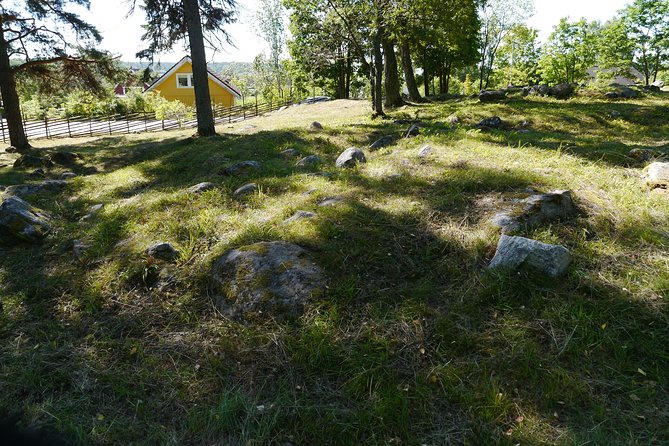
The grave field includes more than 20 skeletons from an early Viking Age Christian burial ground. You may also hear about Estrid’s possible farm and the daily life of the people who lived in this part of Sweden. The guide explains how people dressed and traveled, and how their communities were organized.
Do not expect a dramatic ruin. Much of the value comes from listening and looking closely. The stones and burial ground sit in a countryside setting, and the guide’s explanation supplies the missing context. Without that help, you might simply see grass, stones, and a few low remains.
This stop is especially useful if you want to understand the change from older Norse beliefs toward Christianity. The burial ground gives the subject a physical anchor. It also shows that Viking society included women with status and influence, not just warriors whose names survived in sagas.
Jarlabanke’s bridge and the language of power
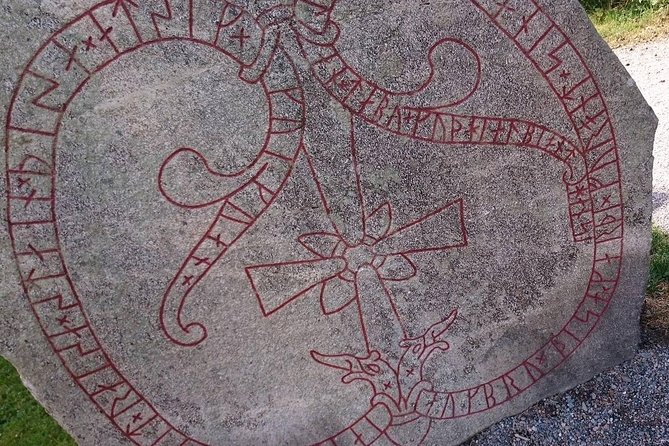
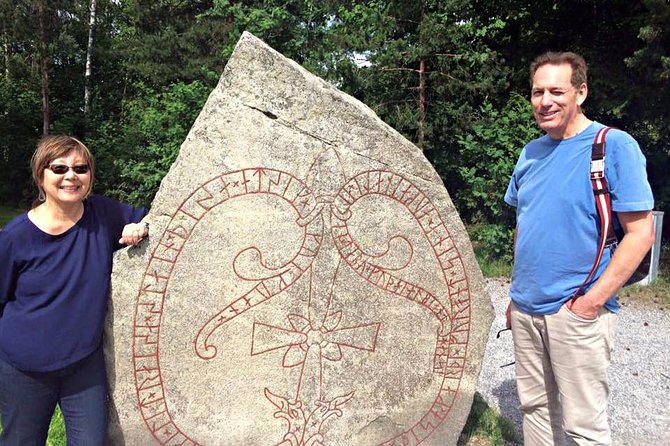
Next comes Jarlabanke Runestones, with about 20 minutes for the visit. Here you walk along and over part of Jarlabanke’s famous Viking bridge, a causeway said to have stretched about 150 meters and to have been built around the year 1030.
The word bridge can mislead you. This is best understood as a constructed route or causeway, marked by stones and linked to movement through the area. Your guide explains the runestones and the message Jarlabanke wanted people to read.
Jarlabanke was a powerful local lord, and his stones project confidence. They tell you about ownership, status, family, and public claims. The writing is not private decoration. It is a statement placed where people could see it.
This is one of the tour’s strongest moments because you are not merely told that Viking leaders had social power. You can see how a person used construction and writing to make that power visible. The stones also help you understand runestones as memorials and political notices, not simply ancient alphabet exercises.
The visit is short, so pay attention from the start. Wear shoes that are comfortable for walking outdoors, and keep your questions ready. If you want every rune translated line by line, three hours may feel tight. If you want the main message and its setting, the timing works well.
Arkils tingstad and Viking law
The third stop is Arkils tingstad, a preserved Viking assembly place. Plan on about 30 minutes here. It sits beside a lake, adding a calm setting to a subject that could be anything but calm.
A thing was a public meeting where local leaders and communities dealt with law and order. This stop helps you picture Viking society as a tribal and legal system, not a world ruled only by personal force. Your guide explains how disputes could be handled and how laws were enforced.
The topics are direct. You hear about divorce laws and punishments connected with killing or insulting another person. These details make the legal system easier to grasp because they connect large ideas about authority to ordinary human conflict.
The site is preserved, but it is not a functioning historical village. There are no actors or staged hearings. You stand in the meeting place, hear the stories tied to the stones, and look across the lakeside surroundings while your guide reconstructs how the assembly may have worked.
I find this stop valuable because it adds a civic side to the tour. Broby focuses on family and burial. Jarlabanke’s bridge focuses on status and public messaging. Arkils tingstad shows how a community made decisions. Together, the stops give you a broader picture than a single rune monument could provide.
More viking history days
- Stockholm: The Viking Museum Exhibition and Viking Ride
★ 4.5 · 667 reviews - Entrance ticket to The Viking Museum
★ 4.0 · 301 reviews - Viking History, Runes & Countryside 9h Tour to Sigtuna & Uppsala
★ 4.5 · 283 reviews - Viking History and Swedish Countryside Tour to Sigtuna & Uppsala
★ 4.5 · 162 reviews
Vallentuna Church and the road from pagan to Christian Sweden
The final stop is Vallentuna Church, a 13th-century church visited for about 30 minutes. It offers a change of mood and material after the open-air sites.
Inside, you can see a plain, reform-era church interior. Your guide contrasts it with the vivid painted interiors associated with earlier Catholic churches. You also hear about the masons’ signatures from the church’s construction, a small but human detail that reminds you that medieval buildings were made by named workers, not by anonymous history.
The church also contains a well-known Jarlabanke rune stone. That link brings the tour back to the earlier stop, while the building itself moves the story forward into medieval Sweden. You are no longer looking only at Viking-age memorials in fields. You are seeing how later religious and social changes shaped the same region.
Another unusual detail is the first known written Swedish ending rhyme, which is found in the church. Your guide explains why that inscription matters for the development of the Swedish language.
This is a satisfying final stop, but its appeal depends on your interests. If you care about writing, language, church history, and the transition to Christianity, it adds a lot. If you only want Viking-age outdoor monuments, you may find the church less exciting than the grave field or causeway.
What the private format adds
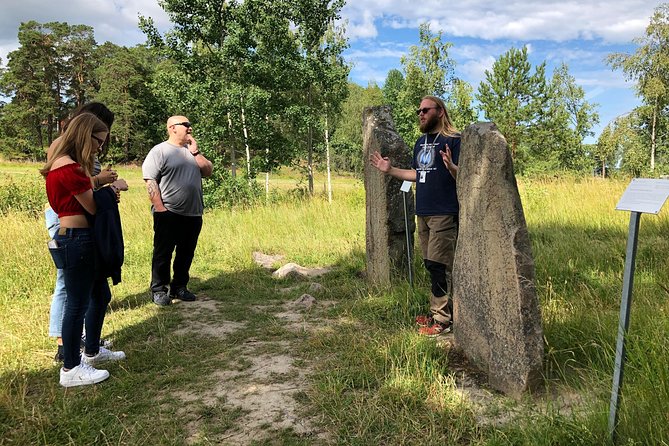
The private format is the tour’s clearest practical advantage. Your guide can explain a point at the level you need, rather than delivering a fixed speech to a large bus group. You can ask about mythology, clothing, burial customs, runic writing, or the difference between historical evidence and later Viking legend.
The guides bring different strengths. Olof has been praised for handling detailed questions about Viking culture and practice. Charlotte has been described as punctual, friendly, and good at setting the sites in their natural and regional context. Karl has added extra sights for some groups, while Quentin, an archaeologist, has led the route from a cruise port and explained Viking life, leaders, and runes in depth.
That does not mean every guide delivers the same experience. One poor account describes a very quiet guide and a tour that felt less informative than expected. This is worth taking seriously. A private tour depends heavily on the person assigned to your group, so it is sensible to state your interests when you book or reconfirm.
The vehicle also saves time. Driving from central Stockholm to the sites takes roughly 30 minutes, with another 30 minutes back. The listed stops total about two hours, which leaves little room for delays. Traffic can change transfer times, and the exact pickup schedule is confirmed later.
Is $431.94 per person a fair price?
At $431.94 per person, this is expensive for a three-hour activity. Two people pay about $863.88 in total. The price makes more sense if you value a private car, hotel or port pickup, a dedicated guide, and the ability to see four sites that are not practical to connect quickly by ordinary city transport.
The value is strongest for a small group of two to five people. Split among several people, the private vehicle and guide become easier to justify. A family also gets more control over questions and pace than on a standard group outing.
The price is harder to defend if you want a long day, major archaeological ruins, or admission to a large museum. There are no separate entrance tickets listed because the stops are outdoor sites and a church, and the tour remains short. You are paying mainly for transport, interpretation, and convenience.
I would compare it with the cost and effort of arranging several taxis or trying to reach the countryside on your own. If you are in Stockholm for only a short stay or arriving by cruise ship, the convenience has real value. If you have several free days and enjoy independent travel, you may prefer to visit a museum first and decide later how much Viking archaeology you want.
Pickup details for hotels and cruise ships
Central hotel pickup is included within five kilometers of Stockholm Central Station. Cruise-port pickup is available at the listed meeting arrangements for Stadsgården, Frihamnen, and Värtahamnen. The instructions are pier-specific, so check your ship’s arrival information before the morning of the tour.
At Stadsgården, the guide meets outside the fences and guards near the S165 or S167 area. At Frihamnen, the meeting point is outside the terminal’s sliding doors for ship F638. At Värtahamnen, walk toward the tourist buses near ship V523, where the guide waits with a sign marked Viking Tours.
Nynäshamn is the important exception. Pickup is not included there because the port is about 50 kilometers from central Stockholm. You need to arrange a meeting in central Stockholm and follow directions by train or cruise bus.
Bring practical outdoor clothing and shoes. The tour includes walking around grave fields, stones, a causeway, and a lakeside assembly site. Service animals are allowed, and the activity is near public transport, but the experience itself relies on private vehicle transfers between rural stops.
Who will enjoy this tour most?
I would choose this for you if you want Viking history tied to actual places, rather than only stories in a museum. It suits adults who enjoy archaeology, inscriptions, early Christianity, local law, and the way ordinary communities were organized.
Families can also make it work. Two 11-year-old children reportedly enjoyed the more dramatic stories, while adults appreciated the added detail. The guide can explain myths and realities side by side, which helps younger visitors avoid treating every Viking tale as proven fact.
The tour is also a good choice for cruise passengers who want something beyond central Stockholm. You get countryside, old monuments, and a return to the city within the morning. Some guides have suggested afternoon stops or dropped people at places such as Stockholm City Hall or the Stockholm History Museum, but those extras are not promised as part of the standard tour.
You may want to skip it if your interest in Viking history is slight. One stop has limited visible remains, and the overall experience is built around listening, interpreting, and imagining the past. Even the most impressive sites are not enormous. This is a thoughtful history outing, not a spectacle.
Final verdict: book it for place-based Viking history
Book this tour if you want a focused, private introduction to Viking-era Sweden and value door-to-door transport. The strongest parts are Estrid’s grave field, Jarlabanke’s causeway, and the assembly site, where the stones make family, law, and power feel concrete.
Think twice if the $431.94 price feels high for three hours or if you expect a reconstructed settlement. Before booking, confirm your pickup point, tell the operator what interests you, and remember that Nynäshamn pickup is excluded.
For the right visitor, this is a smart way to turn a short Stockholm stay into a morning among real runestones and old meeting places. Just bring curiosity, comfortable shoes, and realistic expectations about what survives.
FAQ
How long does the Viking history tour last?
The tour lasts approximately three hours, including private transfers between central Stockholm and the sites outside the city.
What time does the tour start?
The scheduled start time is 9:30 a.m. Your exact hotel pickup time is confirmed during reconfirmation.
Is hotel pickup included?
Yes. Pickup and drop-off are included for central hotels and other accommodations within five kilometers of Stockholm Central Station. If your accommodation is farther away, you receive another meeting point.
Can I be picked up at a cruise port?
Yes, pickup is provided at the specified meeting arrangements for Stadsgården, Frihamnen, and Värtahamnen. Pickup is not included at Nynäshamn Harbour.
What places does the tour visit?
The route visits the Viking grave field in Täby associated with Estrid, Jarlabanke Runestones and the Viking causeway, Arkils tingstad assembly site, and Vallentuna Church.
Is this a private tour?
Yes. Only your group participates, and the experience includes a private guide, driver, and vehicle. At least two people are required to book.
What is the cancellation policy?
You can cancel for a full refund up to 24 hours before the scheduled start time. Cancellations or changes made less than 24 hours before the start are not accepted for a refund.
More 3-Hour Experiences in Stockholm
- Best of Stockholm Walking Tour-3 Hours, Small Group max 10 people
★ 5.0 · 645 reviews - Classic Stockholm Small Group Walking Tour | 3 Hours
★ 5.0 · 96 reviews - Stockholm Must See – Old Town, boat + Vasa Museum 3h small group
★ 4.5 · 34 reviews - 3-Hour Private Walking Tour in Stockholm
★ 5.0 · 26 reviews
Just added around Stockholm
- Beautiful Stockholm Small Group Walking Tour★ 5.0 · 3 reviews
- ROYAL Castle Skokloster and Viking Sigtuna (private tour)★ 4.5 · 3 reviews
- Private Golden Hour Photo Walk in Stockholm★ 5.0 · 3 reviews
- Stockholm Port to Stockholm Arlanda Airport (ARN) – Departure Private Transfer★ 3.5 · 3 reviews
- Swedish Beer Tasting Tour in Stockholm Old Town Pubs★ 5.0 · 3 reviews
- Stockholm Ghost Hunt: Self-Guided Tour and Puzzle Adventure★ 4.5 · 3 reviews
- Private Photography workshop in Stockholm★ 5.0 · 3 reviews
- Private blood, ghosts and folklore Old Town 2h Stockholm tour★ 4.0 · 3 reviews
Stockholm Tours, compared.

Stockholm: City Archipelago Sightseeing Cruise with Guide
Read our review →
Stockholm: Skansen Open-Air Museum Admission Ticket
Read our review →
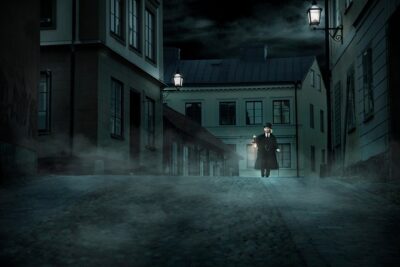
The Original Stockholm Ghost Walk and Historical Tour – Gamla Stan
Read our review →
Browse the lists this tour appears in