
Reviewed · STOCKHOLM TOURS
Stockholm Old Town and the Vasa Museum, a Small Group Walking Tour.
The most memorable part of this tour is the contrast between Stockholm’s medieval Old Town and the Vasa Museum’s enormous 17th-century warship. You begin with stories of ice-age islands, kings, religion, and war, then cross the water by ferry to see a ship that sank on its first voyage and was raised 333 years later.
I like the small group of no more than 10 people, which makes it easy to ask questions and get help with photos. I also like the ferry ride to Djurgården, a welcome break after walking cobblestone streets. The main drawback is pace: this is a brisk three-hour introduction, and the guided museum visit lasts only about 30 minutes, so you need extra time afterward if you want to see the Vasa displays properly.
Key points to know
- A clear first look at Stockholm: You cover Gamla Stan, Riddarholmen, the Royal Palace, Stortorget, and several major historical figures.
- A short ferry ride adds variety: The Djurgårdsfärjan gives you a new view of Stockholm’s waterways before the final walk to the museum.
- Vasa Museum admission is included: You avoid the ticket line and receive an orientation to the ship and exhibits.
- The group stays small: A maximum of 10 people gives you better access to guides such as Natalie and Bengt.
- Expect about 1.5 miles of walking: Much of it is on old cobblestones, so comfortable shoes matter.
- Plan to stay after the tour: The Vasa Museum deserves more time than the guided portion allows.
A strong introduction to Stockholm in three hours

This tour works best as an opening chapter to your Stockholm visit. It does not attempt to give you hours inside every attraction. Instead, it links the city’s main sights into one story, from Stockholm’s first written mention in 1252 to the modern Swedish state.
The route begins at 10 a.m. at Munkbrogatan 8, near Gamla Stan Metro station. The guide meets you downstairs in front of the Pressbyrån kiosk. That detail matters because the meeting point can be easy to miss if you wait on the street or confuse the metro station with a tram stop.
The experience is offered in English and uses a mobile ticket. It is usually booked well ahead, with an average booking time of about 68 days. That suggests you should reserve early if the 10 a.m. start fits your plans, especially during a busy season.
The tour costs $125.77 per person. That is not a bargain-priced walking tour, but the fee includes the Vasa Museum entrance and the ferry ride, along with a small group and a guide for the full route. I see the best value here in the structure: you get your bearings, learn what you are looking at, and finish at one of Stockholm’s most important museums without wasting time in the entry line.
More Walking Tours in Stockholm
- Stockholm: Ghost Walk and Historical Tour
★ 4.7 · 2,206 reviews - Walking Tour of Stockholm Old Town
★ 5.0 · 1,175 reviews - The Original Stockholm Ghost Walk and Historical Tour – Gamla Stan
★ 4.5 · 1,165 reviews
Riddarholmen sets the historical stage
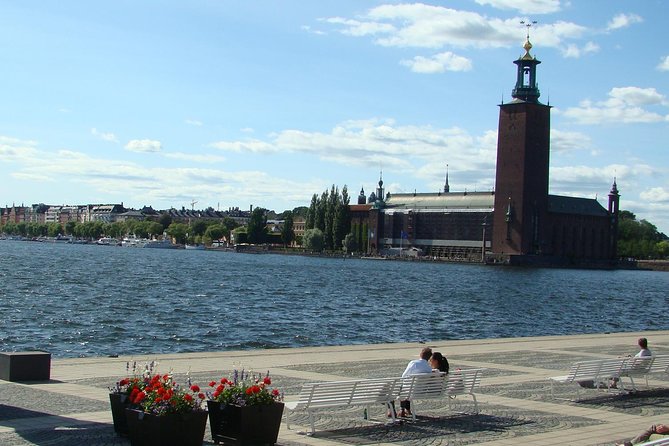
The opening stop is Riddarholmen, or Knights Island, across from the main part of Gamla Stan. From here, you get a fine view toward Lake Mälaren and Stockholm City Hall. The guide begins far back, discussing the ice age, the islands, and the first settlements that led to the city.
That broad opening gives the rest of the walk some order. Stockholm can feel like a collection of islands, bridges, palaces, and narrow lanes. Once you understand how water shaped the city, the map becomes easier to read.
Outside Riddarholmen Church, you meet the statue of Birger Jarl, regarded as the founder of Stockholm. The city first appears in a surviving written document from 1252, when Birger Jarl signed a paper that mentioned Stockholm. The stop is brief, but it anchors the city’s beginnings in a specific date rather than a vague legend.
The guide may use visual aids and old images during the walk. This is especially useful when you are looking at a building that has changed over the centuries. Guides Natalie and Bengt have been praised for bringing historical pictures and other materials that help you compare past and present Stockholm.
Gustav Vasa, the Royal Palace, and the Swedish state
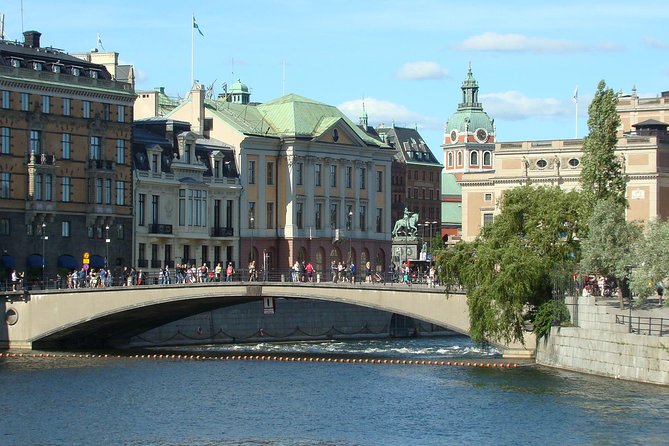
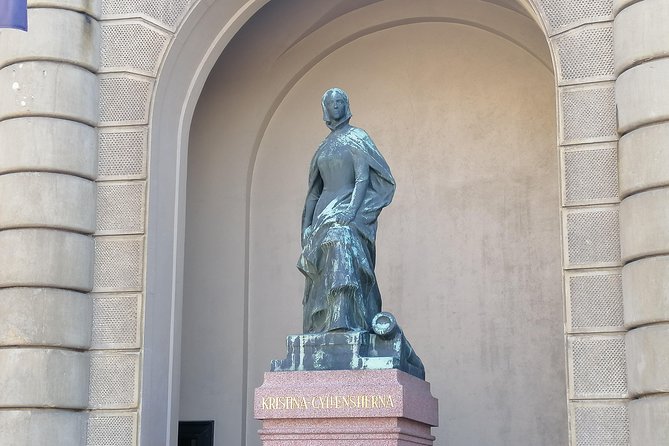
At Riddarhuset, the House of Nobility, the story turns to Gustav Vasa. His statue recalls a major break in Swedish history. After the Stockholm Bloodbath, when his father and many other noblemen were killed, Gustav led an uprising against Danish control.
Gustav Vasa entered Stockholm in 1523. Sweden has remained a sovereign state since then, and the guide connects that political change to another major shift: Gustav’s move from Catholicism to Lutheran Protestantism. You get a short lesson in war, power, religion, and nation-building without being buried under dates.
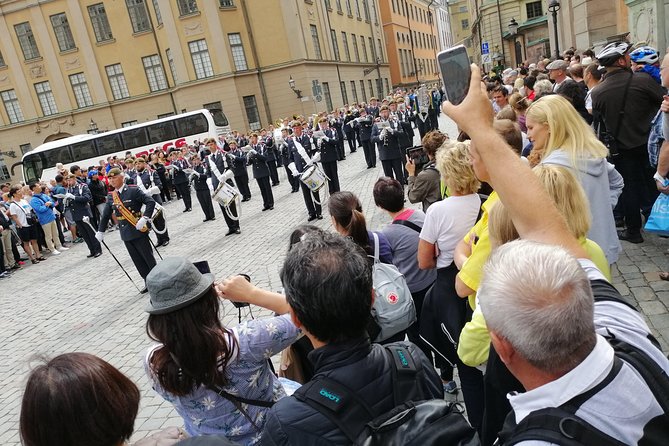
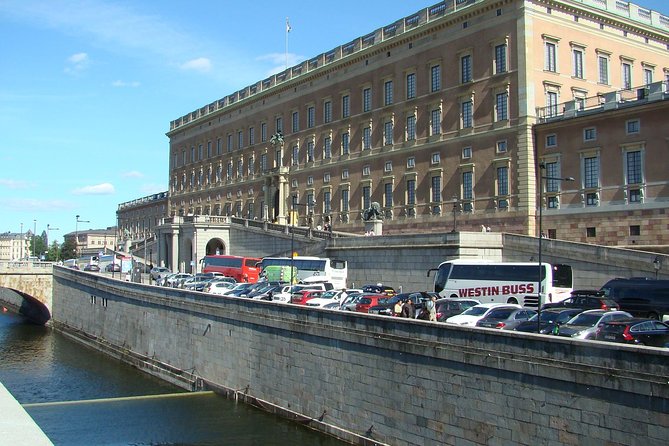
The Royal Palace comes next. You enter the outer courtyard, see the guards in formal uniforms, and walk to Slottsbacken for a view toward Stockholm’s inner harbor. The palace stop is mostly about orientation rather than a full palace visit, so do not expect to tour the royal rooms as part of this experience.
I like this part because it gives you useful context for later sightseeing. If you return to the palace on your own, you already know where it fits into Sweden’s political story. The views from Slottsbacken also offer a natural pause for photos.
Tiny statues and a grand square
One of the quicker stops is Järnpojken, a small iron statue often called the smallest statue in Sweden. It is easy to walk past, which is exactly why a guide helps. Small details like this add personality to a city tour and break up the larger royal and political subjects.
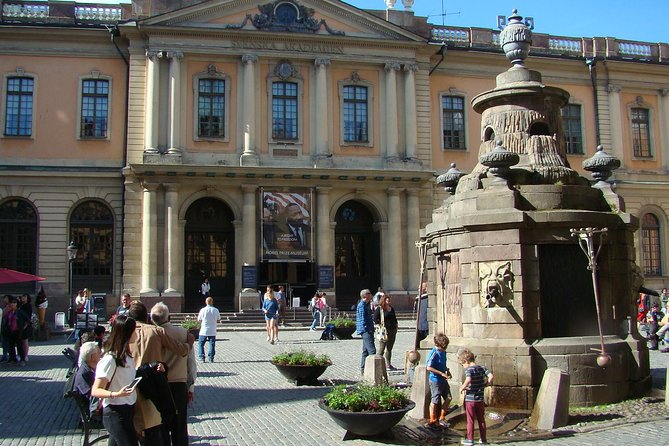
At Stortorget, the main square of Gamla Stan, the Nobel Prize Museum gives the guide a chance to explain Sweden’s role in science, art, and public life. The Swedish Royal Academies select winners in several major fields, and the square itself is one of the most recognizable places in Stockholm.
Stortorget is also a good place to slow down visually. You will see colorful historic façades, narrow streets leading away from the square, and the dense medieval pattern that makes Gamla Stan feel different from modern Stockholm. The tour does not enter the Nobel Prize Museum, so note it as a possible return visit rather than part of the included admission.
The Old Town section lasts most of the first part of the tour. You walk about one mile through the area, stopping often for explanations and pictures. A guide may also point out shops, restaurants, and places worth returning to later. Several people particularly appreciated receiving dining suggestions and lists of other Stockholm sights.
More old town walks in Stockholm
- Stockholm: Old Town Walking Tour with Local Guide
★ 4.7 · 719 reviews - Walking Tour of Stockholm’s Old Town, Gamla Stan
★ 5.0 · 451 reviews - Stockholm: Old Town Historical Walking Tour
★ 4.9 · 344 reviews - Old Town Tour of Stockholm
★ 4.0 · 289 reviews
From Bernadotte kings to modern Sweden
Near the statue of Carl XIV Johan, the guide continues the story into the 19th and 20th centuries. Carl XIV Johan was the first Bernadotte king, brought from France at the start of the 19th century. The original hope was that he would help Sweden recover territory lost to Russia, but his reign took a more diplomatic path.
The discussion moves toward peace, infrastructure, education, industrial growth, natural resources, and Swedish inventions. Sweden celebrated 200 years of peace in 2014. This section helps explain how the country moved from royal conflict and European power struggles toward the modern welfare state.
I find this useful because many short Old Town walks stop with medieval Stockholm or the royal family. Here, the story reaches the society you see today. The guide also has room to answer questions, and the small group makes that easier than on a large coach tour.
The historical material can come quickly. One four-star assessment found the guide moved fast and shared a great deal of information. That is a fair warning. If you prefer long pauses at each building, this may feel brisk. If you want a well-filled overview before exploring on your own, the pace is more likely to suit you.
The Djurgården ferry gives your legs a break
At Skeppsbron 26, you board the Djurgårdsfärjan for Djurgården. The crossing is short, but it changes the feel of the experience. After the close lanes and hard paving of Gamla Stan, you get open water, fresh views, and a chance to rest your feet.
The ferry also shows why Stockholm is often called a city of islands. From the water, the palace area and waterfront buildings make more sense as part of a larger harbor city. It is a simple ride, but it adds a local transport experience that a bus tour cannot provide in quite the same way.
After arriving on Djurgården, you walk about half a mile to the Vasa Museum. The total walking distance is about 1.5 miles, or 2.4 kilometers, spread across the tour. The pace is described as slow, with stops for photos and adjustments when needed, but cobblestones and several hours on your feet still require moderate fitness.
Wear shoes with good support. This advice is more important than it sounds, particularly if you have already spent the morning walking Stockholm or are dealing with leg or balance problems. One person found Old Town tiring and wished for more time at the museum, while others found the pace comfortable. Your experience will depend partly on how much walking you have done before the 10 a.m. meeting.
Why the Vasa Museum is the payoff
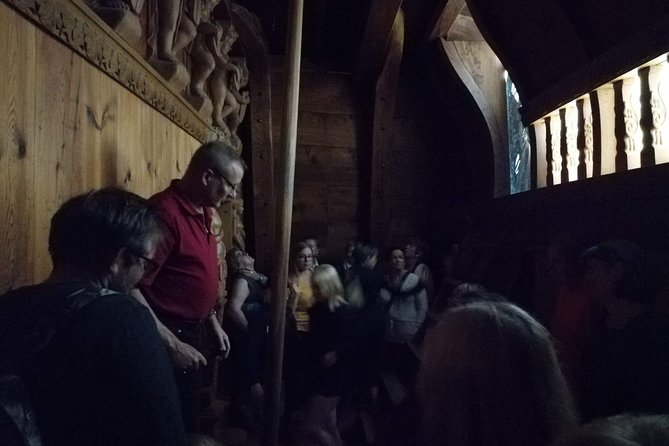
The Vasa Museum houses the warship Vasa, which sank on its maiden voyage after sailing less than a mile. More than 300 years later, the ship was salvaged in remarkably complete condition. The guide explains the basic story and points out the ship and key displays during the included portion.
The museum is not a quick photo stop. Vasa’s size, carved decoration, and survival make it one of Stockholm’s strongest attractions, and the building gives you several ways to understand the ship. A short orientation helps you know what to look for before the guided tour ends.
About 30 minutes of the scheduled experience takes place inside the museum. That is enough for an introduction, but not enough for most people to see everything at a relaxed pace. You are allowed to remain inside after the guided tour, and you should plan to do so. A realistic extra visit is 1.5 to 2 hours, according to the practical guidance provided for the experience.
The museum also has a café or restaurant, so you can continue at an unhurried pace rather than rushing straight to your next stop. If the Vasa is a major reason you want to book this tour, protect the afternoon for it.
Djurgården offers several other attractions after the tour, including the ABBA Museum, the Viking Museum, Gröna Lund, and Skansen. None is included, but ending at the Vasa Museum puts you in a useful position for continuing your day on the island.
Guides who add more than a script
The guides named in the feedback include Natalie and Bengt Nykvist. Their approach appears to be a major part of the experience. Natalie is described as especially organized, prepared with historical pictures, and ready with restaurant and museum suggestions. Bengt is noted for his dry humor, visual aids, patience, and help with onward directions.
That kind of practical help can matter as much as the facts. Several guides have taken photos for people at stops, helped late arrivals find the group, and offered suggestions for the rest of a Stockholm stay. You should still arrive on time, but the small format allows more personal attention than a large scheduled group.
The tour also seems adaptable within limits. The guide can adjust the walking pace and pause while people catch up or take pictures. Still, do not mistake adaptable for slow. The route covers a lot of ground, and the information comes in a steady stream.
Who should book this experience
I would choose this tour for a first day in Stockholm, especially if you want a clear map of the city before deciding which sights deserve a longer visit. It suits couples, families with older children, and small groups who prefer a personal guide to a large coach outing.
It is also a good choice if you are arriving by cruise ship and have limited time. The route covers major Old Town sights, adds a ferry ride, and ends at the Vasa Museum, one of the city’s essential stops.
You may want something else if your priority is a long, quiet museum visit or a slow architectural walk. The Old Town portion is active, the streets are uneven, and the Vasa introduction is short. People who dislike walking or need frequent seated breaks should consider the 2.4-kilometer route carefully.
Cancellation is free up to 24 hours before the start time for a full refund. Changes or cancellations inside that window are not accepted, and the tour requires a minimum number of people to run.
Is Stockholm Old Town and the Vasa Museum worth $125.77?
For $125.77, this is best viewed as a guided orientation rather than a full-day sightseeing package. You pay for a small English-speaking group, a carefully connected route, ferry transport, and Vasa Museum admission. The included entry is useful when lines are long, and the guide’s recommendations can help you use the rest of your stay well.
I would book it if you want history explained in plain language, enjoy walking, and like finishing at a major museum where you can continue alone. I would skip it if you already know Gamla Stan well, want to spend most of the morning inside Vasa, or prefer to explore at your own pace.
For most first-time visitors, the strongest plan is simple: take the tour, then stay at the Vasa Museum for another 1.5 to 2 hours. Bring good shoes, arrive at the underground Pressbyrån meeting point early, and keep the afternoon open for Djurgården. That makes the price easier to justify and turns a fast introduction into a satisfying day of Stockholm sightseeing.
FAQ
How long is the Stockholm Old Town and Vasa Museum tour?
The tour lasts approximately three hours, beginning at 10 a.m.
Where does the tour start?
The meeting address is Munkbrogatan 8 in Stockholm. The guide meets you downstairs inside Gamla Stan Metro station, in front of the Pressbyrån kiosk.
Where does the tour end?
The guided tour ends at the Vasa Museum, at Galärvarvsvägen 14 on Djurgården.
Is the Vasa Museum ticket included?
Yes. Entry to the Vasa Museum is included, and the guide provides an introduction to the ship and displays.
Can I remain in the Vasa Museum after the tour?
Yes. You are welcome to stay after the guided portion and explore the museum independently.
How much walking is involved?
The tour covers about 1.5 miles, or 2.4 kilometers. About one mile is in Gamla Stan, followed by about half a mile from the ferry to the Vasa Museum.
Are the streets difficult to walk on?
Parts of the route use cobblestone streets. Good walking shoes and a moderate level of physical fitness are recommended.
How large is the group?
The group has a maximum of 10 people.
Is the ferry ride included?
Yes. The route includes a ride on the Djurgårdsfärjan from Skeppsbron to Djurgården.
What language is the tour offered in?
The tour is offered in English.
More Museums in Stockholm
- Stockholm: Skansen Open-Air Museum Admission Ticket
★ 4.5 · 3,427 reviews - Stockholm: Nobel Prize Museum and Exhibition Entry Ticket
★ 4.3 · 994 reviews - Stockholm: Fotografiska Museum Entrance Ticket
★ 4.5 · 702 reviews - Stockholm: The Viking Museum Exhibition and Viking Ride
★ 4.5 · 667 reviews
More Vasa Museum Visits
- Stockholm Pass: Save up to 50% – Includes Vasa Museum Ticket
★ 4.1 · 2,392 reviews - Vasa Museum Guided Tour, Including Ticket & Guide
★ 5.0 · 330 reviews - Stockholm Pass: Save up to 50% – Includes Vasa Museum
★ 3.5 · 225 reviews - Stockholm Must See: City Hall, Gamla Stan and Vasa Museum
★ 4.9 · 73 reviews
Just added around Stockholm
- Beautiful Stockholm Small Group Walking Tour★ 5.0 · 3 reviews
- ROYAL Castle Skokloster and Viking Sigtuna (private tour)★ 4.5 · 3 reviews
- Private Golden Hour Photo Walk in Stockholm★ 5.0 · 3 reviews
- Stockholm Port to Stockholm Arlanda Airport (ARN) – Departure Private Transfer★ 3.5 · 3 reviews
- Stockholm Ghost Hunt: Self-Guided Tour and Puzzle Adventure★ 4.5 · 3 reviews
- Swedish Beer Tasting Tour in Stockholm Old Town Pubs★ 5.0 · 3 reviews
- Private Photography workshop in Stockholm★ 5.0 · 3 reviews
- Private blood, ghosts and folklore Old Town 2h Stockholm tour★ 4.0 · 3 reviews
Stockholm Tours, compared.

Stockholm: City Archipelago Sightseeing Cruise with Guide
Read our review →
Stockholm: Skansen Open-Air Museum Admission Ticket
Read our review →
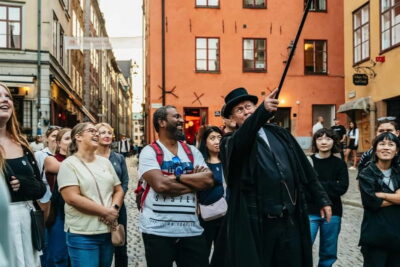


The Original Stockholm Ghost Walk and Historical Tour – Gamla Stan
Read our review →
Browse the lists this tour appears in