
Reviewed · STOCKHOLM TOURS
The Story of Stockholm and Sweden in Three Chapters, a Small Group Walking Tour
Stockholm’s story comes into focus on this compact walk through Gamla Stan. You move from the medieval founding of the city to Gustav Vasa, Sweden’s rise and fall as a great power, and the modern country that produced IKEA and Spotify. The three-chapter structure gives the tour a clear thread instead of a pile of disconnected dates.
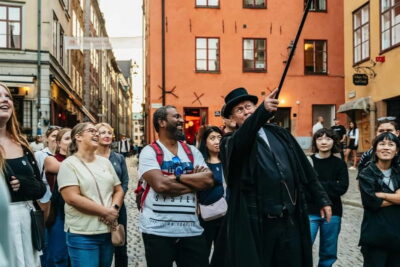
I like the small group limit of 10, which should make it easier to hear the guide and ask questions. I also like the smart route, which uses statues, bridges, the Parliament, the Royal Palace, and Stortorget as outdoor history lessons. The main drawback is pace: two hours is enough for a strong introduction, but not enough for long palace visits or detailed museum time.
Key points to know before you book
- Three clear chapters: Follow Sweden from its earliest settlements through the monarchy, wars, democracy, and modern business culture.
- A walk through major landmarks: See Riddarholmen, Riddarhuset, Parliament, the Royal Palace, and Stortorget.
- Small group format: The experience is capped at 10 people, a useful size for a history-focused walk.
- English-language storytelling: The tour is offered in English and starts at 10:00 a.m.
- A useful modern connection: The final chapter links Sweden’s industrial growth and inventions with companies such as IKEA and Spotify.
- Good timing near the palace: The walk ends close to the Royal Palace, with a chance to see the changing of the guards if the schedule lines up.
Stockholm’s story in three easy chapters
This is not a tour built around entering every major attraction. It is an outdoor walking lesson, using the streets and monuments of central Stockholm as its classroom.
That approach works well here. Stockholm can feel like a collection of islands, palaces, bridges, and attractive old buildings unless you understand how the pieces fit together. This walk gives you a basic timeline: first settlements and medieval Stockholm, the Vasa kings and the Swedish state, then the end of imperial ambition and the rise of modern Sweden.
I would choose this tour early in a Stockholm visit. The information should help you make sense of other places you see later, including the Royal Palace, Nobel Prize Museum, and the city’s modern design and business culture.
The meeting information needs a quick check before you set out. The booking details give Munkbrogatan 8 as the starting address, while the walking directions say to meet inside or beneath Gamla Stan Metro station, in front of the Pressbyrån kiosk. Both locations are in the same old-town area, but you should confirm the exact meeting point after booking so you do not lose time at 10:00 a.m.
More Walking Tours in Stockholm
- Stockholm: Ghost Walk and Historical Tour
★ 4.7 · 2,206 reviews - Walking Tour of Stockholm Old Town
★ 5.0 · 1,175 reviews - The Original Stockholm Ghost Walk and Historical Tour – Gamla Stan
★ 4.5 · 1,165 reviews
Chapter One: Riddarholmen and the first Stockholm
The opening stop is a historical marker on Riddarholmen. Here, the guide begins well before medieval Stockholm, touching on the Ice Age and the first settlements on the islands.
That broad opening matters. Sweden’s story is not only about kings and wars. Geography shaped the country from the beginning, and the islands around Stockholm helped make the city an important meeting point. You will start to see why the capital developed around water rather than on one continuous block of land.
The first section includes a walk around the area and a look at open parts of the palace. The stop is listed at about 15 minutes, so expect an introduction rather than a full architectural study. If you want detailed information about every church, palace room, or medieval street, this will feel quick.
The next stop is outside Riddarholmen Church, where you meet Birger Jarl in statue form. He is considered the presumed founder of Stockholm. The year 1252 is especially useful to remember because it is the first known written mention of Stockholm that survives today.
I like this kind of stop because it turns an abstract date into a physical place. You are not simply told that Stockholm appeared in a document. You are standing near one of the figures tied to the city’s foundation, while the guide explains how the story began.
The church itself is not listed as an interior visit, and admission is free at these stops. Treat this part as a concise orientation to medieval Stockholm, not a church tour.
Chapter Two: Gustav Vasa, war, and the Swedish state
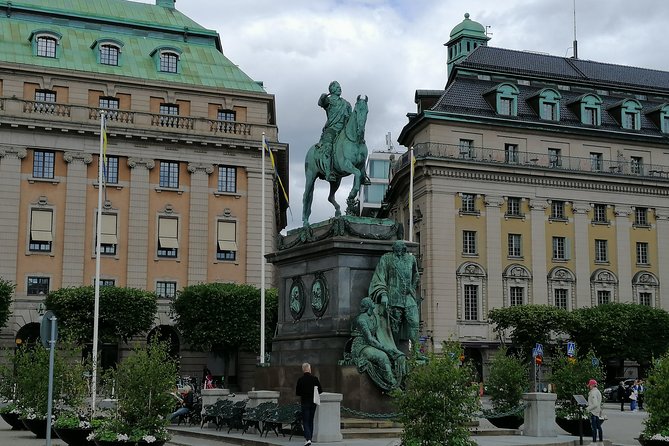
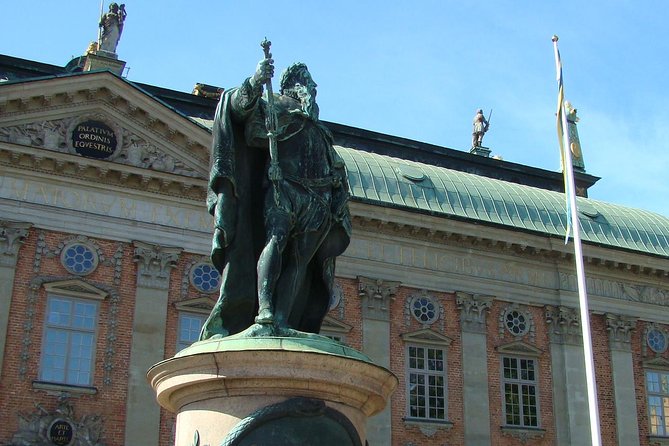
At Riddarhuset, the House of Nobility, the story shifts to Gustav Vasa. His statue marks a major break in Swedish history.
Gustav Vasa entered Stockholm in 1523 after leading an uprising against Denmark’s control of Sweden. His rise followed the Stockholm Bloodbath, in which his father and many other noblemen were killed. The story is dramatic, but its real importance is political: Gustav helped create the independent Swedish state.
The guide also covers his decision to move Sweden from Catholicism to Lutheran Protestantism. That change affected worship, government, property, and daily life. It is a good example of how religious policy and royal power were closely tied together in sixteenth-century Europe.
You will hear a lot at this stop in roughly 10 minutes. The subject is important, but the format favors a brisk overview. If you already know the Reformation and the Vasa period well, you may want more detail. If the names are new to you, this is a useful starting point.
From Vasabron, the bridge near Riddarhuset, the story turns to Gustav Vasa’s heirs. His grandson, Gustav II Adolf, is presented as Sweden’s great warrior king. During his reign, Swedish power spread around much of the Baltic Sea, making it nearly an inland Swedish waterway.
This is one of the tour’s best uses of place. From a bridge, you can connect the water around you with Sweden’s military ambitions. The Baltic was not just scenery. It was a route for trade, armies, and political influence.
The stop lasts about 10 minutes. You will not get a full account of Sweden’s campaigns, but you should leave with a basic sense of how a northern kingdom became a major European power.
Parliament and the long road to voting rights
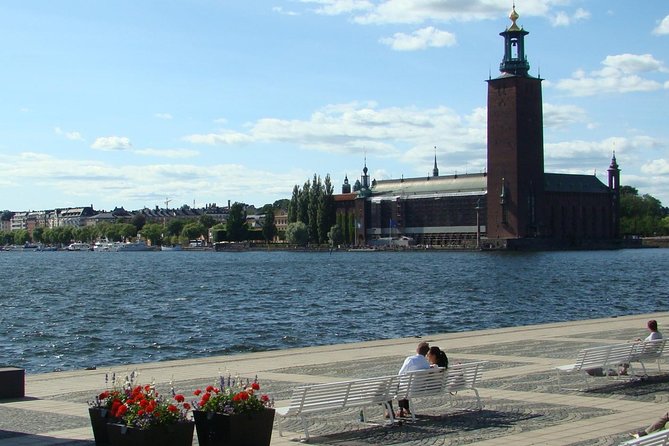
The Parliament Building adds a needed change of subject. After kings and battlefields, the focus turns to political representation.
The guide explains the old Riksdag of the Estates, where nobles, clergy, burghers, and peasants met separately before speaking with the King. That system lasted until 1866 and ranked among the country’s highest authorities beside the monarch.
In 1866, Sweden introduced a two-chamber parliament, but voting still did not belong equally to all citizens. General suffrage came only with the first elections in 1921, after a long political struggle led by liberals and socialists.
This stop helps keep the tour from becoming a parade of royal names. Sweden’s modern identity rests not only on kings and military victories, but also on slow political change. You get a simple timeline showing that democracy was not present from the start and did not arrive all at once.
The Parliament stop is outside, lasts about 10 minutes, and does not include a building visit. I would listen closely here, since the explanation provides useful context for the modern Swedish state that appears in the final chapter.
Something quite different in Stockholm:
- Stockholm: City Archipelago Sightseeing Cruise with Guide
★ 4.3 · 10,798 reviews - Stockholm: Skansen Open-Air Museum Admission Ticket
★ 4.5 · 3,427 reviews - Stockholm: Archipelago Boat Tour
★ 4.4 · 3,110 reviews - Stockholm: Highlights Boat Tour
★ 4.3 · 2,542 reviews
Chapter Three: The Royal Palace and the end of empire
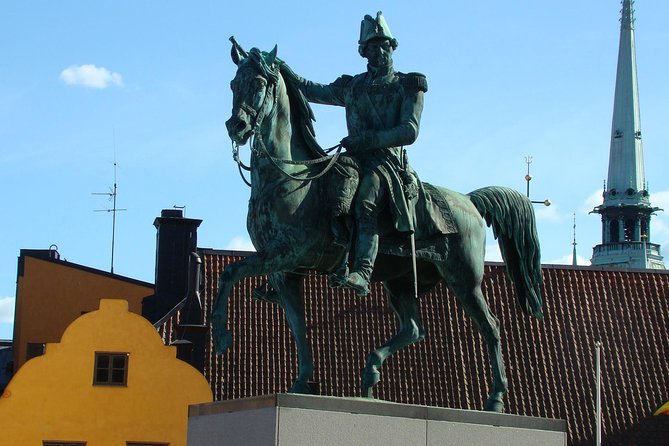
At Lejonbacken, on the north side of the Royal Palace, the tour begins its third chapter. This is the point where Sweden’s era as a northern great power comes to an end.
The guide uses the statue of Karl XII to introduce the conflict with Russia. Karl XII and his Carolean army won early victories, but Peter the Great defeated Swedish forces at Poltava in 1709. The king’s statue still points east, a small physical detail that gives the story a memorable finish.
This is also one of the more atmospheric parts of the walk. The Royal Palace provides a grand setting, while the story moves from ambition to defeat. Sweden did not remain a dominant military power forever, and the guide makes that turn easy to follow.
The walk then touches on the Enlightenment and Gustav III, a king with strong interests in theatre, art, and science. The phrase enlightened despot may sound contradictory, but it captures the period well: a ruler could support learning and culture while still holding great political power.
Again, the stop is brief, around 10 minutes. You will get the main direction of the story, not a full treatment of Gustav III or Swedish cultural life. For most people seeing Stockholm for the first time, that level should be enough to provide context without turning the morning into a lecture.
Carl XIV Johan and Sweden’s peaceful modern turn
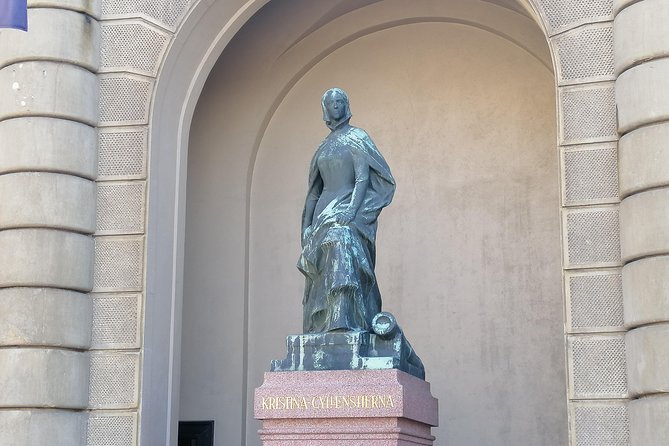
Below the statue of Carl XIV Johan, the story moves into the nineteenth century. He was the first Bernadotte king, brought from France at the start of the century with the hope that he could help Sweden recover territory lost to Russia.
Instead of making another major military push, he focused on diplomacy, infrastructure, and education. That choice helps explain an important part of Sweden’s modern character. The country’s strength did not come only from conquest. It also came from stability and long-term investment.
In 2014, Sweden celebrated 200 years of peace. The tour uses that milestone to connect the monarchy and nineteenth-century politics with the industrial revolution, natural resources, Swedish inventions, and the development of a welfare state.
The final section also reaches into the twentieth and twenty-first centuries. Swedish entrepreneurs continued that economic development, producing globally familiar companies such as IKEA and Spotify.
I like this ending because it gives you a bridge from old Stockholm to the Sweden you recognize today. IKEA and Spotify are not random name drops. They show how the country’s story moved from natural resources and industrial growth toward design, technology, and international business.
The stop lasts about 20 minutes, making it one of the longer sections. That extra time is useful because modern Sweden involves several connected ideas: peace, education, infrastructure, invention, social policy, and entrepreneurship.
Stortorget, the Nobel Prize, and the tour’s finish
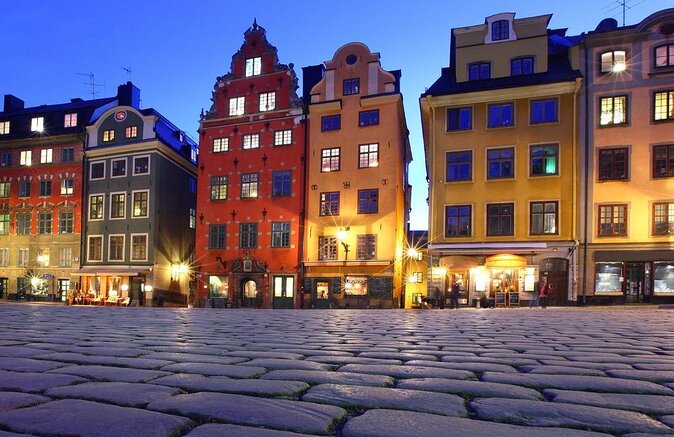
The walk ends at Stortorget, the main square in Gamla Stan. The Nobel Prize Museum is here, and the guide explains the role of the Swedish Royal Academies in choosing winners in important fields of science and art.
This is a fitting final stop. The tour began with the first written mention of Stockholm and ends with Sweden’s international reputation for science, culture, and ideas.
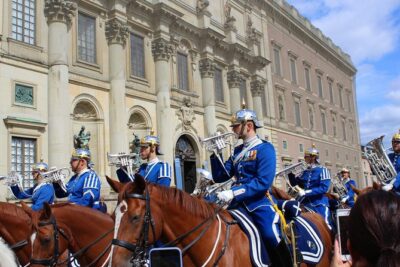
The tour also ends close to the Royal Palace, which may put you in good position to see the changing of the guards. The parade is a popular attraction, and during summer the Music Corps may march or ride through to the palace’s Outer Courtyard.
The timing is not guaranteed as part of the walking tour, so you should treat the guard ceremony as a possible extra, not the main reason to book. Still, finishing near the palace gives you a practical way to continue your morning.
From Stortorget, you can also spend more time in Gamla Stan, visit the Nobel Prize Museum, or return to the palace area. The tour does not end in an isolated part of town.
What the $61.28 price gives you
At $61.28 per person, this is not the cheapest way to walk through Gamla Stan. Its value depends on how much you want a guide to connect the landmarks.
You are paying for about two hours of structured explanation, an English-language guide, and a group capped at 10 people. Admission is included along the route, but the listed stops are primarily outdoor locations and free-access areas. There is no indication that the price includes a full interior visit to the Royal Palace, Riddarholmen Church, Parliament, or the Nobel Prize Museum.
I think the price makes the most sense for first-time visitors who want a clear introduction and prefer asking questions rather than reading plaques. It is less compelling if you already know Swedish history or mainly want to enter museums and spend time inside monuments.
The small group helps justify the cost. A maximum of 10 is far more manageable than a large crowd around a statue or bridge. You should be able to stay near the guide and follow the story without straining to hear every sentence.
The overall rating is 4.6 from seven reviews, a positive result but based on a small sample. The strongest praise centers on the tour being fun and educational. One person had a tight schedule and took a shorter version, then said they would have liked to continue and would book it again. That is useful evidence for anyone with limited time: the tour can work as a flexible history introduction, but the full route is the better choice if your schedule allows.
Walking conditions and who will enjoy it
You need a moderate level of physical fitness. The experience involves moving between several central Stockholm locations, with stops lasting from 10 to 20 minutes. The tour is not designed as a seated lecture.
Wear comfortable shoes and plan for ordinary city walking. The tour is near public transportation, and the start in the Gamla Stan area makes it practical to reach from elsewhere in Stockholm.
I would recommend it most for:
- First-time visitors who want historical bearings quickly
- Couples, families, or solo visitors who prefer a small group
- People interested in how Sweden moved from monarchy and warfare toward democracy and industry
- Anyone curious about the connection between old Stockholm and companies such as IKEA and Spotify
- Visitors with a free morning who want to continue exploring near the palace afterward
I would be more cautious if your main goal is extensive interior sightseeing. The experience is about interpretation and connections, not long visits inside each landmark.
You should also allow for weather. The itinerary is an outdoor walk, and the supplied details do not describe a weather backup plan. Check the forecast and dress for conditions before you leave.
Should you book this Stockholm walking tour?
Book it if you want a concise, well-organized introduction to Sweden and you like history tied to real places. The three-chapter format is easy to follow, the route covers the essential old-town sights, and a group of no more than 10 should keep the experience personal.
Skip it if you want a museum-heavy tour, an in-depth royal history seminar, or a long visit inside the palace. At two hours, it gives you the framework rather than every detail.
For most first visits, I would place this walk near the start of your Stockholm plans. Confirm the exact meeting point, arrive ready for city walking, and keep time afterward for Stortorget, the Nobel Prize Museum, or the Royal Palace. Free cancellation is available if you cancel at least 24 hours before the 10:00 a.m. start.
FAQ
Where does the tour start?
The booking information gives Munkbrogatan 8, 111 27 Stockholm, as the starting address. The directions also specify Gamla Stan Metro station, inside or underground, in front of the Pressbyrån kiosk. Confirm the exact meeting point after booking.
What time does the tour begin?
The tour starts at 10:00 a.m.
Where does the tour end?
The walk ends at Stortorget, near the Royal Palace and the Nobel Prize Museum.
How long does the tour last?
The tour lasts approximately two hours.
What language is the tour offered in?
The tour is offered in English.
How large is the group?
The group has a maximum of 10 travelers.
Is admission included?
Admission is included along the way. The listed stops are mainly outdoor locations and free-access areas, including open parts of the palace.
Do I need to be physically fit?
You should have a moderate level of physical fitness because the experience is a walking tour with several stops around central Stockholm.
Is the tour near public transportation?
Yes. The tour starts in the Gamla Stan area, near public transportation.
Can I cancel for a full refund?
Yes. You can cancel for a full refund up to 24 hours before the experience starts. Cancellations or changes made less than 24 hours before the start time are not accepted for a refund.
Just added around Stockholm
- Beautiful Stockholm Small Group Walking Tour★ 5.0 · 3 reviews
- Private Golden Hour Photo Walk in Stockholm★ 5.0 · 3 reviews
- ROYAL Castle Skokloster and Viking Sigtuna (private tour)★ 4.5 · 3 reviews
- Stockholm Port to Stockholm Arlanda Airport (ARN) – Departure Private Transfer★ 3.5 · 3 reviews
- Stockholm Ghost Hunt: Self-Guided Tour and Puzzle Adventure★ 4.5 · 3 reviews
- Swedish Beer Tasting Tour in Stockholm Old Town Pubs★ 5.0 · 3 reviews
- Private Photography workshop in Stockholm★ 5.0 · 3 reviews
- Private blood, ghosts and folklore Old Town 2h Stockholm tour★ 4.0 · 3 reviews
Stockholm Tours, compared.

Stockholm: City Archipelago Sightseeing Cruise with Guide
Read our review →
Stockholm: Skansen Open-Air Museum Admission Ticket
Read our review →
The Original Stockholm Ghost Walk and Historical Tour – Gamla Stan
Read our review →
Browse the lists this tour appears in