

Reviewed · SWEDISH LAPLAND TOURS
Discover Kiruna: A Walk Through History and Nature
Kiruna’s story is written in iron, stone, and timber. This private two-hour walk links the town’s mining roots with the Monument of Ancient Iron Miners, an enigmatic Stone Circle, and Kiruna Church, the famous wooden church known for its Gothic Revival design.
I like the route’s clear sense of place, and I like that it ends at the church rather than simply circling back to the starting point. You get both human history and quiet northern scenery. The main concern is value: at $290.89 per person, with free admission at every stop, the cost is high unless you value a private guide and a focused introduction to Kiruna.
Key points to know before you book
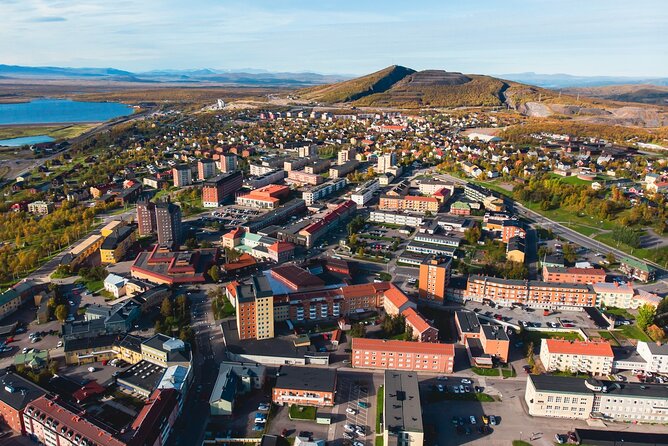
- A private route from LKAB to Kiruna Church: Only your group participates, so the pace and conversation can feel more personal than on a large group outing.
- Mining is the central thread: LKAB’s Visitor Centre and the Monument of Ancient Iron Miners explain why Kiruna exists and how iron shaped its identity.
- Four stops fit into about two hours: The schedule gives the church and Stone Circle 30 minutes each, with 20 minutes at the visitor centre and 40 minutes at the mining stop.
- The final church visit is a highlight: Kiruna Church is a striking wooden building with a carefully crafted altar and a calm interior.
- The route mixes famous and less familiar sights: You get a major local landmark alongside the Stone Circle, a site linked with old stories and ritual.
- The price calls for comparison: Group discounts are available, but the experience is non-refundable and cannot be changed after booking.
Kiruna in two hours: a compact introduction to the town
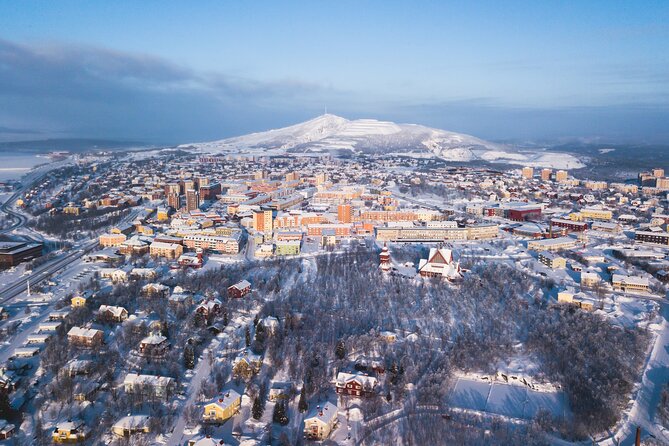
Kiruna is far north in Sweden, in a region often associated with open wilderness, snow, mining, and Sámi culture. This walk does not try to cover every part of that broad story. Instead, it gives you a compact path through four places that help explain how the town developed.
That narrow focus is useful if you have limited time. You are not left to connect unrelated sights on your own. The route begins with industry, moves to a tribute to miners, then turns toward an older and more mysterious site before ending in a church built in a distinctive national style.
The tour lasts about two hours. That is long enough to give each stop some attention, but short enough to fit around other plans. I would see it as an orientation walk, not a full-day exploration of Kiruna. You get the basic framework, then you can decide which parts deserve a longer visit on your own.
Because it is a private activity, only your group takes part. The supplied information does not name the guide, so you should not book expecting a particular guide or specialist by name. The guide’s ability to explain the town clearly will matter a great deal, since the admission costs are free and much of the value comes from interpretation.
More Kiruna outings to compare
- Stockholm: Ghost Walk and Historical Tour
★ 4.7 · 2,206 reviews - The Original Stockholm Ghost Walk and Historical Tour – Gamla Stan
★ 4.5 · 1,165 reviews - Stockholm: Old Town Historical Walking Tour
★ 4.9 · 344 reviews
LKAB’s Visitor Centre and Kiruna’s industrial roots
The first stop is LKAB’s Visitor Centre on Malmvägen 9B. You have about 20 minutes here, with admission included.
LKAB is central to Kiruna’s development, and this opening stop gives the rest of the walk its purpose. Interactive exhibits explain the mining industry, the technology used to support it, and the work that has shaped life in northern Sweden. You are not simply looking at an old monument later in the tour. You first get a sense of the modern industry behind the town.
Twenty minutes is a brisk amount of time. You should expect an introduction rather than a detailed technical tour. If you are fascinated by mining machinery, engineering, or the way a working industry affects a town, you may wish the schedule allowed longer here.
Still, beginning indoors is practical, especially in winter. Kiruna can be cold, and an exhibition space gives you a warm starting point before the outdoor portions. It also helps you understand why the next stop matters.
The Monument of Ancient Iron Miners
The second stop is listed as Kiruna Mine and centers on the Monument of Ancient Iron Miners. You have about 40 minutes, making it the longest stop.
The monument honors generations of iron miners who worked below ground. Its role is not just decorative. It points to the human cost and effort behind Kiruna’s economic growth. Mining can sound like a story of ore, machinery, and production, but this stop brings the focus back to people.
The description does not say that you enter the mine itself. You should therefore expect a visit connected with the monument and mining heritage, not an underground mine tour. That distinction matters, especially if you are booking because you want a subterranean experience.
The 40-minute allocation allows room for explanation and questions. It also gives the guide time to connect the mining industry with Kiruna’s identity. I like this part of the route because it avoids treating the mine as merely a technical attraction. The monument gives the town’s workers a visible place in its public story.
At the same time, the experience will be less satisfying if you want active demonstrations or a long museum visit. The available information describes the monument as a tribute, not an attraction with a stated program of machinery, tunnels, or hands-on activities.
The Stone Circle and Kiruna’s older stories
After the mining stops, the route shifts tone at the Stone Circle. You spend around 30 minutes here.
The site is presented as an ancient place linked with legends, rituals, and mysterious rites. That language sets an important expectation: this is a place for atmosphere and interpretation, not a clearly explained museum exhibit. You may find the Stone Circle most rewarding if you enjoy old sites whose meaning is partly tied to story and tradition.
The contrast with LKAB is one of the route’s best features. The visitor centre represents modern industry and applied technology. The Stone Circle turns your attention toward a much older past, where stones and oral stories carry more weight than machines and displays.
You should keep your expectations measured. The information does not provide an archaeological date, detailed account of the circle’s construction, or confirmation of specific rituals. A good guide can explain what is known and separate fact from local lore. Without that care, the stop could feel vague.
Thirty minutes is enough for a thoughtful pause without letting the site take over the whole walk. In winter, the setting may be particularly striking, with snow changing the look of the stones and surrounding ground. One earlier account of the experience praised Kiruna’s winter scenery, and this stop is likely to benefit most from that seasonal setting.
More walking tours in Kiruna
- Walking Tour of Stockholm Old Town
★ 5.0 · 1,175 reviews - Stockholm: Old Town Walking Tour with Local Guide
★ 4.7 · 719 reviews - Best of Stockholm Walking Tour-3 Hours, Small Group max 10 people
★ 5.0 · 645 reviews - The Nordic Food Walk Stockholm
★ 4.5 · 642 reviews
Kiruna Church: a calm finish in Gothic Revival timber
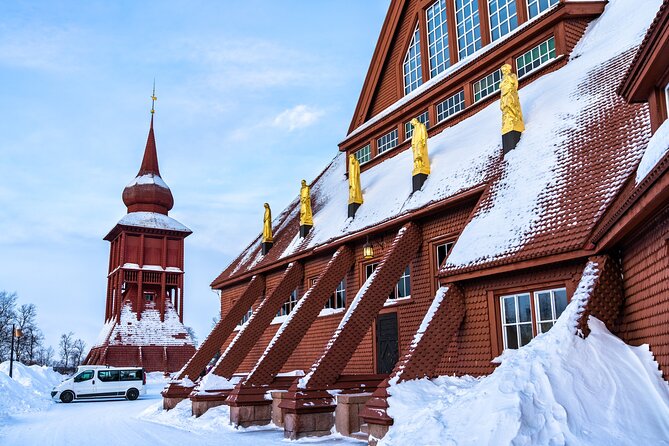
The final stop is Kiruna Church on Finngatan 1. You have about 30 minutes to see the building and its interior.
Kiruna Church is a wooden structure with distinctive Gothic Revival architecture. It is also described as the largest wooden building in Sweden, a detail that gives the visit extra weight. Even if you are not an architecture enthusiast, the scale and material make this different from the stone churches found in many European towns.
Inside, the mood changes again. The church offers a quiet place to pause after the industrial and outdoor portions of the route. The altar is a key feature, combining religious purpose with careful artistic design.
I like ending here. A church is not simply another photo stop. It gives the walk a human and reflective close, showing how a remote mining town also created spaces for worship, art, and community life.
The visit is not described as a service or guided religious program. You should expect time to look around and hear about the building, rather than a formal ceremony. Since the church is the endpoint, check that you are comfortable finishing there rather than returning to the LKAB Visitor Centre.
What the route tells you about Kiruna
Taken together, the four stops offer a useful sequence. LKAB explains the town’s modern engine. The miners’ monument puts workers at the center of that story. The Stone Circle reaches toward an older past, and the church reflects the town’s spiritual and artistic life.
That variety is the strongest reason to book. You are not spending two hours on one narrow subject. You get industry, memorial art, local legend, architecture, and northern scenery in one compact outing.
The route also helps you see Kiruna as more than a base for snowy adventures. Winter activities may draw many people north, but this walk explains the place itself. The town has been shaped by work, belief, memory, and the difficult conditions of the far north.
Do not expect a complete account of Sámi culture, the wider region, or every stage of Kiruna’s development. The supplied information points to mining and local heritage, with a church and Stone Circle added for contrast. If Sámi history and culture are your main reason for visiting, you may need a separate experience focused directly on that subject.
Is $290.89 per person fair value?
The listed price is $290.89 per person. That is a substantial amount for a two-hour walk, especially since admission is free at all four stops.
The strongest case for the price is privacy. Only your group participates, which can make it easier to ask questions and keep the pace suited to your interests. A private format may also be useful for families or small groups who do not want to follow a fixed large-group schedule.
Group discounts may improve the cost for some bookings, but the available details do not state the discounted rate. You should check the final price before paying and compare it with other guided walks in Kiruna.
I would consider the price reasonable only if the private format is important to you or if your time in Kiruna is very limited. If you mainly want to see the church and monument, you may find the cost hard to justify. If you want a guide to connect the sights into one coherent story, the calculation becomes more favorable.
The tour is non-refundable and cannot be changed for any reason. That policy makes the high price more important. Book only when your schedule is firm.
Timing, meeting point, and practical comfort

You begin at LKAB’s Visitor Centre, Malmvägen 9B, 981 30 Kiruna. The tour ends at Kiruna Church, Finngatan 1, 981 31 Kiruna. Since the start and end points differ, plan your next move from the church rather than assuming you will return to the original meeting point.
The start is near public transportation, which helps if you are staying elsewhere in Kiruna. The available details do not specify the walking distance between stops, the exact transportation used, or the guide’s accessibility arrangements. Most people can participate, but you should ask the provider directly if your group has specific mobility needs.
A mobile ticket is provided, and confirmation arrives at booking. The tour is offered by Opatrip.com Sweden.
Because part of the experience takes place outside, dress for northern Swedish weather. The information does not provide a seasonal clothing list, so use sensible cold-weather planning if you are visiting during winter. The snowy scenery can add greatly to the mood, but low temperatures can make a 40-minute outdoor stop feel longer than expected.
Who will enjoy this private Kiruna walk?
I would recommend this tour to first-time visitors who want a quick introduction before exploring more of the region. It also suits people who enjoy understanding how a town works, rather than only collecting scenic photographs.
History fans will appreciate the link between the mining displays, the miners’ monument, and the Stone Circle. Architecture lovers will have a clear reason to look forward to the church, especially because of its wooden construction and Gothic Revival style.
Families and small groups may like the private setup. You can ask questions without worrying about keeping up with a large party, and the two-hour duration is manageable.
I would hesitate to recommend it to anyone seeking an underground mine visit, a long museum session, or a dedicated Sámi cultural program. Those interests are not clearly covered by the experience as described.
Should you book Discover Kiruna?
Book it if you want a short, private orientation to Kiruna that connects mining, memorials, ancient stones, and a remarkable wooden church. The route has real variety, and the church gives it a satisfying finish.
Think twice if you are price-sensitive. At $290.89 per person, the free admissions mean you are paying mainly for the private guide, organization, and interpretation. For a small group that values privacy, that may be worthwhile. For one person or a couple seeking basic sightseeing, it is a steep charge for two hours.
My practical advice is to book only after confirming the group discount and deciding how important a private guide is to you. If that format fits your plans, this is a neat way to get your bearings in Kiruna and see more than the usual headline attraction.
FAQ
How long does the Kiruna walking tour last?
The tour lasts approximately two hours. The scheduled stops include 20 minutes at LKAB’s Visitor Centre, 40 minutes at the mining monument, 30 minutes at the Stone Circle, and 30 minutes at Kiruna Church.
Where does the tour begin?
The tour begins at LKAB’s Visitor Centre, Malmvägen 9B, 981 30 Kiruna, Sweden.
Where does the tour end?
The tour ends at Kiruna Church, Finngatan 1, 981 31 Kiruna, Sweden. It does not return to the starting point.
Is this a private tour?
Yes. Only your group participates in the activity.
Are admission tickets included?
Yes. Admission is listed as free at LKAB’s Visitor Centre, the mining stop, the Stone Circle, and Kiruna Church.
Can I cancel or change the booking?
No. The experience is non-refundable and cannot be changed for any reason.
Just added around Kiruna
- Kiruna: Cross-Country Skiing Tour with a Guide★ 5.0 · 3 reviews
- Kiruna: Northern Lights Minivan Chase with Warm Drink★ 4.8 · 4 reviews
- Half day Wildlife and Nature Photography★ 5.0 · 6 reviews
- Kiruna: Northern Light Photo Tour with Equipment★ 5.0 · 7 reviews
- Snowmobile Safari to Lapland viewpoint★ 5.0 · 7 reviews
- Polar Nature Tour on Snowmobile★ 4.4 · 12 reviews
- Northern Lights tour with Reindeer★ 4.5 · 13 reviews
- Kiruna: Reindeer Herder Tour with Sami Dinner and Transfers★ 4.9 · 33 reviews
Swedish Lapland Tours, compared.

Northern Lights Tour from Kiruna to Abisko with Dinner
Read our review →Kiruna: Northern Lights Tour with Stejk Street Food Dinner
Read our review →
Abisko National Park: Scenic Morning Hike with Transfer
Read our review →
Kiruna: Guided Afternoon Drive Your Own Dog Sled Tour
Read our review →
Kiruna: Morning Husky Sled Ride with Coffee Break
Read our review →Browse the lists this tour appears in