
Reviewed · UPPSALA TOURS
Uppsala’s biggest attractions – 1h city walk in Uppsala city.
Uppsala’s most revealing stories are tucked around its university and cathedral. On this guided walk, you hear how a grand building bankrupted its builder, how Olof Rudbeck created an ingenious anatomical theater without proper ventilation, and why Uppsala once tore itself down for a coronation that never happened there. This is a history walk with gossip, odd failures, and big personalities, not just a parade of facades.
I like the local guide format, which brings in figures such as Celsius, Linné, and Rudbeck without turning the hour into a dry lecture. I also like the route’s range: rune stones, medieval church politics, university scandals, a castle murder, and views toward one of Europe’s oldest botanical gardens. Guides Anette and Jonathan are specifically named, and both are praised for making the stories clear and answering questions well.
The main consideration is the pace and structure. One comment describes a walk with plenty of standing and pointing, plus a somewhat jumpy thread, rather than constant movement. Also, the advertised stop times add up to about 75 minutes, although the tour is described as approximately one hour, so check the exact timing when you book.
Key points to know before booking
- Uppsala’s university rivalry with Denmark: The university’s founding is linked to Sweden’s wish to have an institution better than the Danes.
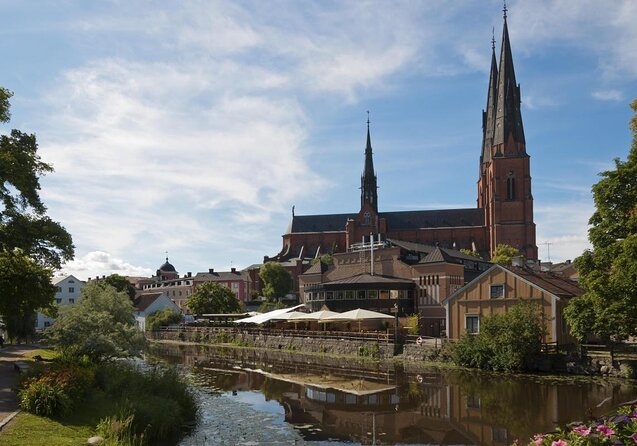
- A cathedral built over centuries: Uppsala Cathedral took shape from the 1270s to the 1430s and is described as the largest cathedral in the Nordic countries.
- Rudbeck’s clever but flawed theater: Learn about the famous anatomical theater and its remarkable design, including its missing ventilation.
- A castle murder and garden views: Uppsala Castle provides one of the tour’s strongest story moments and a view toward the Botanical Garden.
- A city demolished for a coronation: Uppsala was voluntarily torn down before Queen Kristina’s coronation, but the rebuilding fell behind and the ceremony moved to Stockholm.
- A small-group walk with practical limits: The group can include up to 20 people, and admission to Gustavianum and Uppsala Castle is not included.
What this Uppsala walk is really about
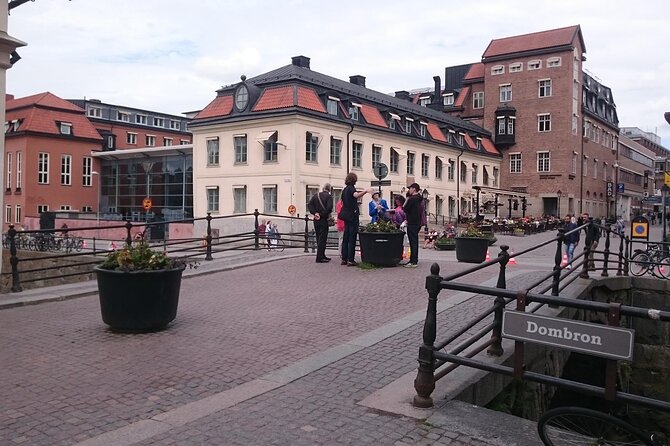
This experience works best as a compact introduction to the city’s power centers. Uppsala is not presented as one neat historical chapter. Instead, you move between the university, cathedral, castle, and civic spaces, seeing how religion, education, royal authority, science, and student life shaped one another.
That mix is the appeal. You do not hear only about famous dates. You hear about builders who overreached, university teachers who sold essays, students living under unusual rules, and city plans that failed at the worst possible time. I find those details more useful than a long list of architectural labels because they help you picture how Uppsala actually functioned.
The walk begins at Riddartorget and returns there at the end. A mobile ticket is provided, and the group can be no larger than 20 people. That is small enough for questions to be possible, though the experience will still feel more like a group walk than a private tour.
More walking tours in Sweden
- Stockholm: Ghost Walk and Historical Tour
★ 4.7 · 2,206 reviews - Walking Tour of Stockholm Old Town
★ 5.0 · 1,175 reviews - The Original Stockholm Ghost Walk and Historical Tour – Gamla Stan
★ 4.5 · 1,165 reviews
University House and the rune stones
The first section focuses on the University House and the university park. You hear about the building’s decorations and the financial trouble they caused its builder. It is a good early example of the tour’s tone: impressive public works often come with private bills, bad planning, and someone paying the price.
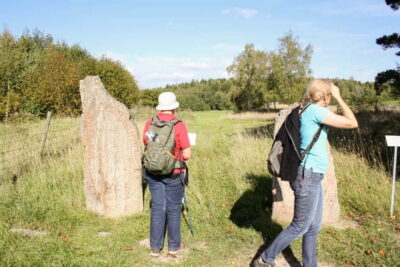
The university park adds a different layer with its rune stones. These connect Uppsala’s academic center with an older Scandinavian past, before the university and cathedral gave the area its better-known shape. I like that the tour begins with this contrast. You get both the grand nineteenth-century university image and traces of a much earlier world.
The listed time here is 15 minutes, with no admission charge. Expect the guide to explain the buildings from outside and to use the surrounding spaces as part of the story. If you prefer a tour that keeps walking every minute, this may feel slower than expected. The route deliberately pauses so the guide can point out details and build the background.
Gustavianum and Rudbeck’s remarkable theater
Gustavianum brings the university’s intellectual history into sharper focus. The discussion includes Olof Rudbeck’s anatomical theater, the old university Academia Carolina, and a party hall whose collections became so large that they had to move through two more buildings.
The anatomical theater is one of the most memorable subjects on the route. Its design was considered brilliant, but it lacked a ventilation function. That small flaw gives the story some needed humor, while also showing how scientific spaces could be ambitious and imperfect at the same time.
You also hear about Celsius, Linné, and Rudbeck, three names that help explain why Uppsala mattered far beyond Sweden. The guide connects people to buildings rather than treating them as isolated famous names. That makes this stop useful if you have heard of Linnaeus or Celsius but do not yet know how they fit into Uppsala’s university world.
The stated stop lasts 10 minutes, and admission to Gustavianum is not included. That distinction matters. You should not assume the tour price covers entry to the museum itself. The experience includes the guided portion described here, but you may need a separate ticket if you want to visit the museum interiors.
The tour also touches on university teachers who sold essays. That detail brings the institution down from its lofty pedestal. Universities have always had rules, shortcuts, status games, and people willing to bend them. It is a useful reminder that Uppsala’s academic past was not made only by perfect scholars.
Uppsala Cathedral and medieval power
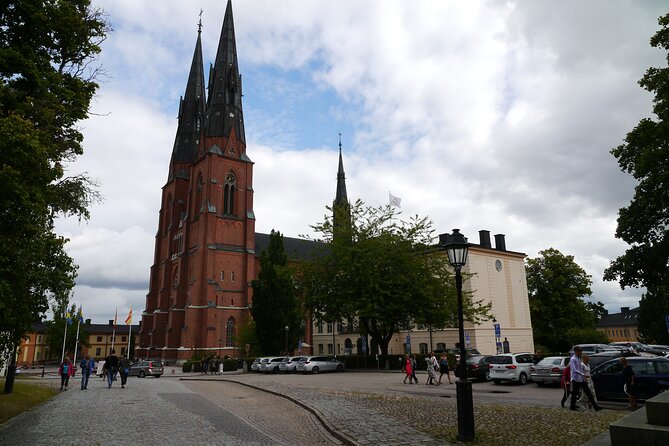
Uppsala Cathedral is the visual heavyweight of the walk. Construction ran from the 1270s into the 1430s, a period long enough to show how medieval building projects could outlast several generations. The cathedral is described as the largest in the Nordic countries, and the tour places it within the wider medieval district around it.
You hear about the canons’ houses and other buildings that once surrounded the cathedral. You also get the less polished side of construction: limestone pipes were paid more than soldiers, leading to strikes. This kind of story gives the building a human scale. A cathedral may look timeless once finished, but its construction involved wages, complaints, supply problems, and political tension.
The tour also returns to the university’s founding and its desire to surpass Denmark. That connection is important. Uppsala’s university and cathedral were not simply local institutions. They were part of a broader effort to give Sweden religious and intellectual strength of its own.
The cathedral portion is listed at 20 minutes and has no separate admission charge. Because the walk is short, you should not expect a full architectural study or a long quiet visit inside. Instead, you get a guided overview and a set of stories that help you notice the cathedral’s role in the city.
More Sweden outings to compare
- Malmö: Express Walk with a Local in 60 minutes
★ 5.0 · 8 reviews - Explore Gothenburg in 60 minutes with a Local
★ 3.5 · 7 reviews - Gothenburg: Express Walk with a Local in 60 minutes
★ 4.8 · 6 reviews - Uppsala bloody history 1h- racial biology, 18th century plague, 19th century prostitution etc.
★ 5.0 · 4 reviews
St. Erik’s Square, Oxblodstorget, and the university city
At St. Erik’s Square and the Consistory House, the focus shifts from monumental buildings to daily control. The guide explains how plague entered Uppsala and discusses the years 1709 to 1711, when the disease affected the city.
Oxblodstorget adds a practical, even messy, detail: meat was sold there. You also hear about sheds connected to the cathedral that were built into the wall surrounding it. These details help you picture a city that was not arranged as a clean museum district. Work, worship, trade, illness, and education occupied the same tight spaces.
The Consistory House is especially useful for understanding university authority. During the 1750s it contained a prison, police, and administration for students. The university was described as a city within the city, with its own systems and discipline. That is a strong idea to carry through the rest of the walk. Uppsala was not merely a town with a university added to it. The university shaped how the town operated.
This section is listed at 10 minutes. It is likely to appeal most to you if you enjoy social history, rules, and everyday life. If you mainly want famous sights, it may feel less dramatic than the cathedral or castle, but it supplies some of the best context.
Uppsala Castle and the view over the Botanical Garden
The final major stop is Uppsala Castle. Here, the guide tells the story of a murder connected with the castle and takes you into the courtyard. From there, you look across toward the Botanical Garden, described as one of the oldest botanical gardens in Europe.
The castle stop brings together royal power, crime, and public views. After hearing about scholars and church officials, you get a reminder that Uppsala’s history also includes court politics and violence. The garden view gives the route a calmer finish, with science and cultivated nature replacing the castle’s darker story.
The listed time is 20 minutes, but admission to Uppsala Castle is not included. As with Gustavianum, clarify what you want to see inside before planning your budget. The guided experience includes the castle-related section and courtyard viewpoint described here, but the supplied details do not promise interior entry.
This is also one of the places where footwear and stamina matter. The activity calls for a moderate physical fitness level. No difficult hiking is described, but you should be comfortable walking between city sights and standing during explanations.
The Queen Kristina story gives the city a strange turning point
One of the most unusual stories concerns Queen Kristina’s planned coronation. Uppsala was voluntarily demolished before the event, apparently to make way for a redesigned city. The rebuilding did not proceed quickly enough, so the coronation was moved to Stockholm instead.
That episode gives the entire walk a useful theme: cities are shaped by plans, ambition, and failure as much as by successful buildings. You can look around Uppsala and imagine the gap between the city officials’ grand intentions and what was actually ready in time.
I also appreciate that this story links architecture with royal ceremony. It is not just a tale about streets being removed. It shows how much a coronation could demand from a city, and how costly a plan became when reality refused to cooperate.
The guides and the feel of the experience
The experience is led by an authorized Uppsala guide. Anette is praised for an engaging presentation and for handling questions, while Jonathan is noted for sharing information that even some Uppsala residents had not known. That is a useful sign for locals who think they already know the city.
The strongest praise centers on the guides’ ability to tell anecdotes and make the city’s past interesting. I would book this for the stories, not simply for directions between sights. You should expect interpretation, explanation, and conversation rather than a silent stroll with a few dates.
At the same time, set your expectations about movement. One piece of feedback describes the activity as more stationary than its name suggests, with the group often standing while the guide points things out. Another concern was the lack of a clear connecting thread. If you need a tightly plotted historical narrative, the changing subjects may feel abrupt.
I see that as a manageable weakness if you arrive ready for a sampler. The tour covers many centuries in little time, so it cannot give every story a long setup. Ask questions when you need a link between one subject and the next.
Is $91.75 a fair price for one hour?
At $91.75 per person, this is expensive for a one-hour city walk. The price includes all fees and taxes, but not gratuities, and separate admission is not included for Gustavianum or Uppsala Castle.
The value depends on how you use it. If you want a fast orientation from an authorized local guide and enjoy specific stories about university life, cathedral politics, scientific history, and royal decisions, the tour can save you research time. You also get a compact route through several of Uppsala’s main sights.
If you are judging it only by walking time, the price is harder to defend. The supplied stop lengths total about 75 minutes, while the overall duration is described as approximately one hour. Confirm the actual schedule before booking, especially if you are paying close to $100 for a short introduction.
I would see this as better suited to a special-interest visitor, a first-time visitor with limited time, or a local who wants fresh stories about familiar streets. If you want museum entry, long cathedral time, or a full afternoon of sightseeing, budget separately and consider how much more time you want on your own.
Who should book this walk?
I would recommend it to you if you like:
- Stories about people, mistakes, scandals, and odd historical choices
- University towns and the way academic institutions shape city life
- A guided overview before exploring Uppsala independently
- Cathedral and castle history with a local explanation
- Small-group tours, with a maximum of 20 people
- A moderate amount of walking and standing
It may not suit you if you want nonstop walking, a very linear story, or a long interior visit at every major building. The tour is broad rather than deep. Its strength is the unusual mix of subjects, from rune stones and medieval canons to student police, plague, and an anatomical theater with no ventilation.
The route is near public transportation, and service animals are allowed. Confirmation is provided at booking. You can cancel for a full refund up to 24 hours before the start time. Changes or cancellations inside that window are not accepted, and the activity requires a minimum number of participants. If that minimum is not met, you are offered another date or experience, or a full refund.
Should you book it?
Book this Uppsala walk if you want a guide to connect the cathedral, university, castle, and Botanical Garden through memorable human stories. Anette and Jonathan are both associated with strong guiding, and the tour’s best material is specific: the bankrupt builder, Rudbeck’s flawed theater, student administration, cathedral strikes, the castle murder, and the coronation plan that sent Queen Kristina to Stockholm.
Think twice if the $91.75 price feels high for roughly an hour, or if you want constant motion and a carefully ordered narrative. For the right visitor, this is an entertaining orientation with more substance than a basic sightseeing loop. For the wrong one, it may feel like several good talks joined by short walks.
FAQ
Where does the Uppsala city walk start?
The tour starts at Riddartorget in Uppsala, Sweden.
Where does the tour finish?
The activity ends back at the meeting point.
How long does the tour last?
The duration is approximately one hour. The listed stop times add up to about 75 minutes, so you should confirm the exact timing when booking.
What is the price?
The listed price is $91.75 per person.
Is the ticket mobile?
Yes. The experience provides a mobile ticket.
Is the guide authorized?
Yes. The walk is led by an authorized Uppsala guide.
How large is the group?
The activity has a maximum of 20 participants.
Is admission to Gustavianum included?
No. Admission to Gustavianum, the Uppsala University Museum, is not included.
Is admission to Uppsala Castle included?
No. Admission to Uppsala Castle is not included.
Can I cancel for a full refund?
Yes, if you cancel at least 24 hours before the experience start time. Cancellations made less than 24 hours in advance are not refunded.
Is the tour suitable for someone with limited fitness?
The activity requires a moderate physical fitness level. It is near public transportation, and service animals are allowed.
Just added around Sweden
- Beautiful Stockholm Small Group Walking Tour★ 5.0 · 3 reviews
- Kiruna: Cross-Country Skiing Tour with a Guide★ 5.0 · 3 reviews
- Arlanda Express Train Airport and Stockholm City Transfer★ 5.0 · 3 reviews
- Gothenburg: Private Walking Tour with a Guide★ 3.6 · 3 reviews
- Karlskrona Self Guided Sherlock Holmes Murder Mystery Game★ 4.0 · 3 reviews
- Private Golden Hour Photo Walk in Stockholm★ 5.0 · 3 reviews
- Half Day Guided Walk with Huskies★ 5.0 · 3 reviews
- ROYAL Castle Skokloster and Viking Sigtuna (private tour)★ 4.5 · 3 reviews
Uppsala Tours, compared.
Stockholm Viking History Full Day Tour to Sigtuna + Uppsala
Read our review →
Uppsala: City Highlights and Hidden Gems Walking Tour
Read our review →
Best of Uppsala: Private Walking Tour with a Local
Read our review →
Guided tour 90min at Old Uppsala mounds and old Uppsala church
Read our review →
Uppsala bloody history 1h- racial biology, 18th century plague, 19th century prostitution etc.
Read our review →
Uppsala Must See 2h city walk – 2h tour of all big attractions!
Read our review →Browse the lists this tour appears in